
Dye Penetrant vs Magnetic Particle Testing: How to Choose

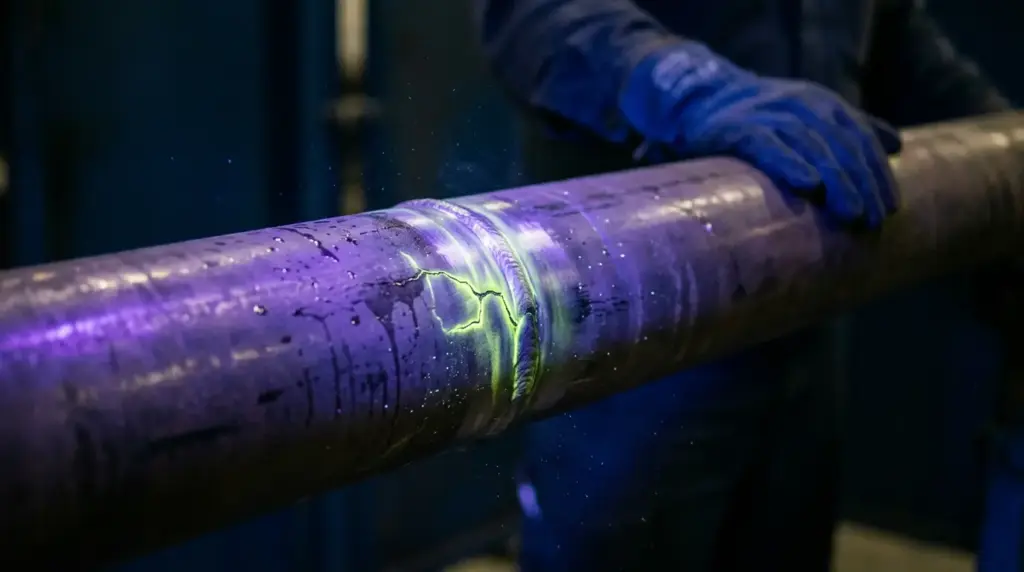
Ask three inspectors how they choose between dye penetrant vs magnetic particle testing and you will get three answers, all of them starting with the same word: depends. It does depend, but not on as much as people make out. In practice one property of the material settles the question most of the time, and everything else is refinement.
Both are surface methods. Both are cheap, portable and fast compared with ultrasonics or radiography. Both are what a fabrication shop reaches for first thing in the morning. And both are usually the first two methods a technician gets certified in, which is why understanding the difference properly matters early rather than late.
The one question that settles most of it
Is the material ferromagnetic?
If it is not, magnetic particle testing is off the table and you use penetrant. Austenitic stainless steels such as 304 and 316, aluminium, copper alloys, titanium, brass, most castings in non-ferrous alloys — none of them will hold a magnetic field usefully, so there is nothing for the particles to gather around. Penetrant does not care what the material is made of, only that the surface is non-porous and reasonably smooth.
If it is ferromagnetic — carbon steel, low alloy steel, cast iron, ferritic and martensitic stainless grades — then both methods are available and the choice moves on to what you are looking for and how fast you need it.
That single question resolves the majority of real jobs. The awkward cases are the duplex and super duplex grades, which are partly ferritic and will take a field, and clad or weld-overlaid components where the surface layer and the parent metal behave differently. Those are worth a conversation with your Level 3 rather than a rule of thumb.
What each one actually finds
This is the difference that matters technically, and it is the one candidates get wrong in interviews.
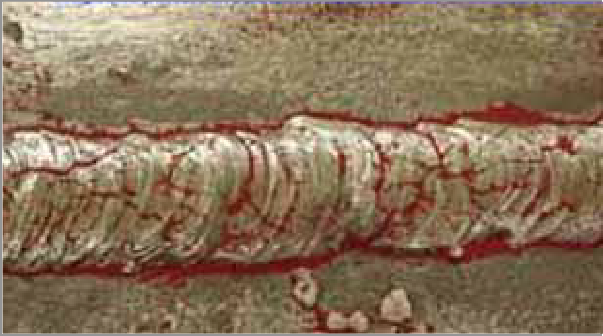
Penetrant testing only finds discontinuities that are open to the surface. The whole mechanism is capillary action: liquid is drawn into the opening, the excess is removed from the surface, and a developer then draws the trapped liquid back out to form a visible indication. If the defect does not break the surface, there is nothing for the penetrant to enter and the test will tell you the part is sound.
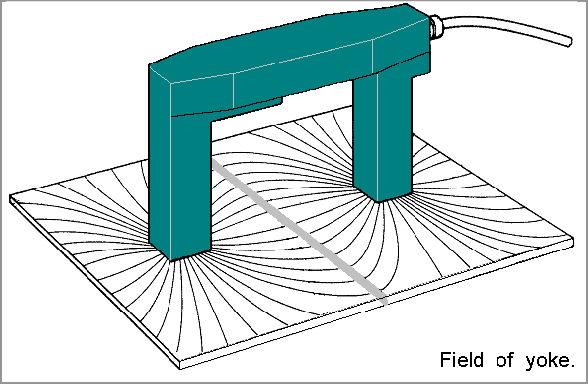
Magnetic particle testing finds surface discontinuities and also picks up ones that sit just below the surface. When a magnetic field runs through a component and meets a discontinuity, the field distorts and leaks out at the surface, and the iron particles gather at that leakage. Because the leakage field spreads slightly, a subsurface defect close enough to the surface still produces a visible indication — though the deeper it sits, the weaker and more diffuse that indication becomes.
So on carbon steel where you suspect underbead cracking or a defect that has not quite broken through, magnetic particle is the better choice. On stainless, penetrant is the only one of the two you can use at all.
How the two tests actually run
The sequences look similar written down and feel completely different on site.
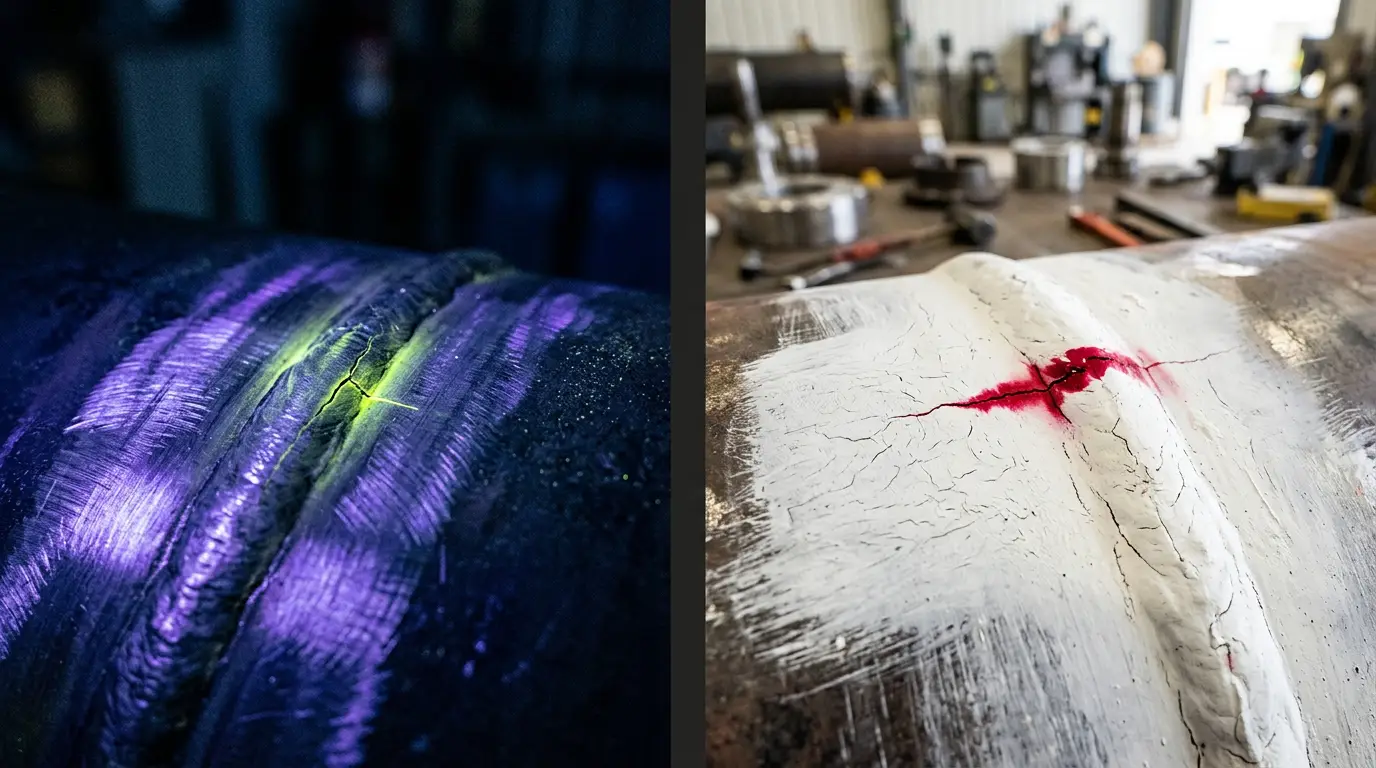
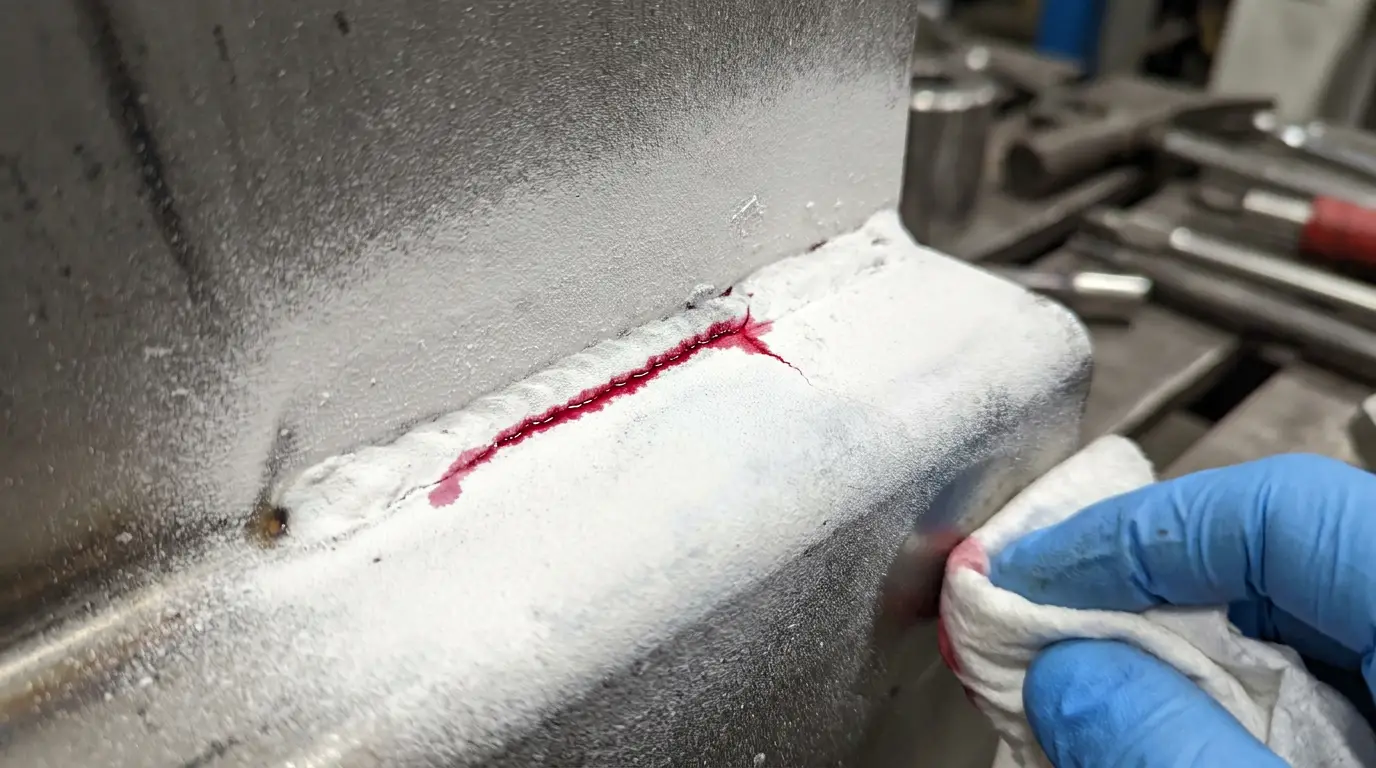
A penetrant test is a series of waits. Clean and dry the surface properly, apply the penetrant, then leave it. That dwell time is not padding — it is the test working, and cutting it short is the most common way inexperienced technicians produce a clean report on a cracked component. Remove the excess penetrant carefully, apply developer, wait again while the indication bleeds out, then inspect within the specified time window. Visible red-on-white is the workhorse; fluorescent penetrant under UV is more sensitive and needs a darkened area.
A magnetic particle test is a series of shots. Clean the surface, magnetise the area, apply the particles while the field is applied, read the indications, move on. Each shot takes seconds rather than minutes. The catch is that the method is directional: indications form best when the discontinuity lies across the field, and a crack running parallel to the field can be missed entirely. That is why the field has to be applied in two directions roughly perpendicular to each other over the same area. Technicians who skip the second orientation to save time are the reason some cracks get found by somebody else later.
The other operational difference is power. A yoke needs electricity. Prods need electricity and bring the risk of arc strikes on the component, which is why many clients ban them outright on finished surfaces. Penetrant needs nothing but aerosols, cloth and light, which is part of why it survives in confined spaces and remote locations where dragging a cable is impractical.
Where each one lets you down
Neither method is difficult to perform badly, and both have failure modes worth knowing before a client points them out.
Penetrant struggles on rough or porous surfaces. An as-welded cap with heavy ripple will trap penetrant in the ripple and produce indications everywhere, so the surface usually has to be dressed first — which costs time and sometimes is not permitted. Over-removal of excess penetrant washes the indication out of the defect and gives you a false clean. Under-removal gives you a background you cannot read. It is also temperature sensitive, generates solvent waste that has to be handled, and it is slow.
Magnetic particle is limited to ferromagnetic materials, it is directional as described, and its sensitivity drops as coating thickness increases — a thick paint system or a heavy galvanised layer will mask fine indications. Prods can burn the surface. Some components come out magnetised and need demagnetising before machining or welding, because residual magnetism deflects arcs and attracts swarf. And in wet fluorescent form it brings its own consumable handling and UV lighting requirements.
Cost, speed and what actually happens on site
On carbon steel, in volume, magnetic particle usually wins on economics. It is quicker per joint, it tolerates a rougher surface, the consumables cost less, and there is far less waiting. A crew running MT on a fabrication line will clear a great deal more weld length in a shift than the same crew running penetrant.
Penetrant wins on reach. It works on anything non-ferrous, needs no power, fits into spaces where a yoke will not, and it is the method most people default to for stainless pipework, aluminium structures, castings and machined components. It also produces a very legible indication when it is done properly, which matters when a client is looking over your shoulder.
In real inspection scopes you often see both on the same job for different components, and neither is regarded as the senior method. They answer slightly different questions.
How the codes see it
The two methods have parallel treatment in most code frameworks, which tells you something about how interchangeable the industry considers them where the material allows.
- Under ASME Section V, liquid penetrant examination is covered in Article 6 and magnetic particle examination in Article 7. The technique requirements live there.
- The acceptance criteria normally do not. They sit in the construction code — for example the mandatory appendices of ASME Section VIII Division 1 — which is why a technician can run a perfect examination and still not know whether an indication is rejectable until they read the right document.
- On the ISO side, ISO 3452 covers penetrant testing and ISO 9934 covers magnetic particle testing, with separate standards giving acceptance levels for welds.
- Structural steel work in North America usually points at AWS D1.1, which sets out both methods and their acceptance criteria for welded connections.
Two warnings. Article, appendix and clause numbering changes between editions, so always work to the edition your contract names rather than the one you learned on. And an examination performed correctly to the wrong acceptance criteria is a wasted examination. Our guide to NDT codes and standards and the overview of the organisations that govern NDT are useful orientation if this side of the job is new to you.
A short decision path
- Not ferromagnetic? Penetrant. There is no decision to make.
- Ferromagnetic, and you want speed on volume weld work? Magnetic particle, with the field applied in two directions.
- Ferromagnetic, but you suspect a defect just under the surface? Magnetic particle.
- Ferromagnetic, but no power available or working inside a tight space? Penetrant.
- Heavily coated component and the coating cannot come off? Neither is reliable. Escalate it rather than issuing a report you do not believe.
- Rough as-welded surface that cannot be dressed? Magnetic particle copes better.
And if the answer genuinely is not obvious, that is a Level 3 question. Choosing the technique is exactly what they are certified to do, which is worth remembering rather than guessing on a Friday afternoon.
Why both belong on your certification list
For anyone building a career rather than passing a single job, the practical answer to dye penetrant vs magnetic particle is: get both. They are the cheapest methods to train and examine in, they cover between them almost every material you will meet, and the pair of them is what gets a new technician onto a fabrication shop floor or a shutdown crew. Almost nobody is hired for penetrant alone.
From there the sensible progression is ultrasonics, because that is where pay separates and where the advanced techniques branch off. If you are mapping out that route, our certification and career pathways guide covers the schemes, and the Level I, II and III overview explains what each level is allowed to sign for. The wider guide to NDT methods puts both surface methods in context alongside the volumetric ones.
Frequently asked questions
Which is more sensitive, dye penetrant or magnetic particle?
For discontinuities that are genuinely open to the surface on a smooth component, penetrant is generally regarded as very sensitive, and fluorescent penetrant more so than visible. Magnetic particle has the advantage of detecting near-surface discontinuities that penetrant cannot reach at all. Sensitivity comparisons only mean something once you have fixed the material, the surface condition and the defect type.
Can you use magnetic particle testing on stainless steel?
On austenitic grades such as 304 and 316, no — they are not sufficiently ferromagnetic. On ferritic, martensitic and duplex grades it can work, because those contain enough ferrite to carry a field. If you are unsure what grade you are looking at, check the material certificate rather than the appearance.
Why does magnetic particle testing need two directions?
Because the method relies on the magnetic field being interrupted by the discontinuity. A crack lying parallel to the field barely disturbs it and may produce no indication at all. Applying the field in two roughly perpendicular directions over the same area means any orientation of crack will be crossed by one of them.
Does dye penetrant find subsurface defects?
No. If the discontinuity does not break the surface, the penetrant has no route in and the test will report the area as acceptable. Anyone who tells you otherwise has misunderstood the mechanism.
Which method should a new technician certify in first?
Most people take penetrant and magnetic particle together, often alongside visual, because they are the quickest and cheapest route to being employable. Which of the two you sit first rarely matters.
The short version
Material first, defect location second, practicality third. If it is not ferromagnetic you are running penetrant. If it is, and you want speed and near-surface detection, you are running magnetic particle in two directions. Everything else is detail — important detail, but detail.
If you hold either certification and you are looking for work, new vacancies go up on the NDT jobs board continuously, you can add your CV to the resume database so recruiters find you directly, and vacancy alerts will email you when something matching your methods appears. Technicians argue about all of the above in the NDT forum, which is usually worth reading.



Responses