
 Join free
 Register your company
 Sign in
Welcome to NDT Inspect's dye penetrant testing group, a place for professionals to connect and discuss the latest techniques and technologies in dye penetrant inspection. Our member group offers a platform for sharing knowledge and best practices on dye penetrant testing and its applications in various industries. Join our community of experts from around the world and be a part of the conversation.
Updates
-
 stig-skarpenes posted an update1 year ago
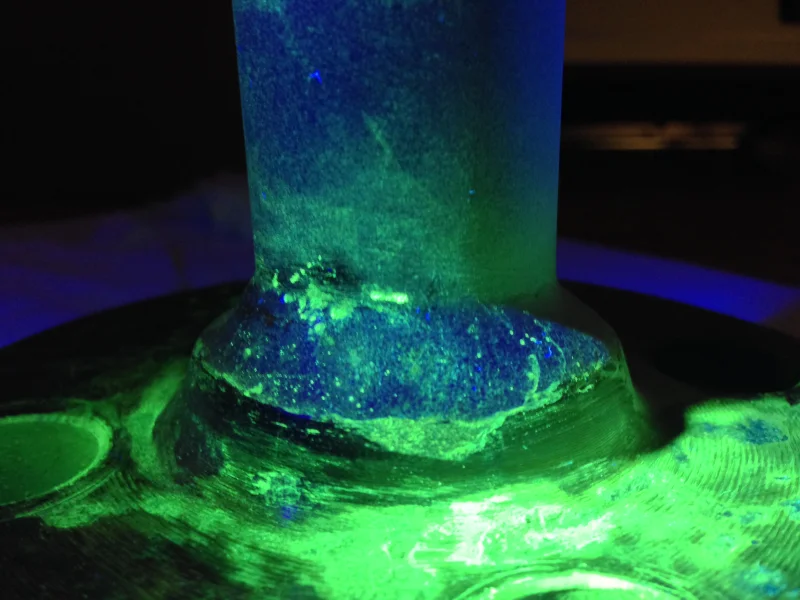
Crackindication found in pin thread roots of an API connection - picture taken after 1 min dwell time.
 👍3
👍3 -
 3 years ago
The process of performing a dye penetrant inspection, also known as liquid penetrant testing, typically involves the following steps:
Surface preparation: The surface of the test object must be clean and free of contaminants, such as dirt, oil, and grease, in order for the penetrant to be effective. The surface is usually cleaned using a solvent or detergent and then dried.
Application of penetrant: The penetrant is applied to the surface of the test object using a brush, spray, or dip method. The penetrant is allowed to penetrate into any surface defects, such as cracks or pores, for a specified time period.
Removal of excess penetrant: Any excess penetrant is removed from the surface of the test object using a cleaner or solvent. This step is important to ensure that the penetrant remaining in the defects is clearly visible.
Application of developer: A developer is applied to the surface of the test object to draw the penetrant out of any defects and create a visible indication of the defects. The developer is allowed to dry for a specified time period.
Inspection: The surface of the test object is examined using a suitable light source, such as a UV light, to identify any indications of defects. The size, shape, and location of the indications are recorded and evaluated to determine the severity of the defects.
Overall, the process of performing a dye penetrant inspection involves carefully preparing the surface of the test object, applying and removing the penetrant, and using a developer to create a visible indication of any defects.
-
NDT-Inspect posted an update in the group Dye Penetrant Inspection (PT) (DPI)3 years ago
Dye penetrant testing, also known as liquid penetrant testing, is a type of nondestructive testing (NDT) method used to detect surface-breaking defects in a wide range of materials, including metals, ceramics, and composites.
The test is performed by applying a liquid penetrant to the surface of the material being tested.
The penetrant is allowed to seep into any surface-breaking defects, such as cracks or pores, and is then removed from the surface. A developer is then applied, which draws the penetrant out of the defects and creates a visible indication that can be easily seen and evaluated.
This method is commonly used to inspect metal parts, such as welds and castings, for defects that could affect their strength and performance.
-
 mohamed-ali-bagath joined the group Dye Penetrant Inspection (PT) (DPI)4 years ago
 -
NDT-Inspect created a poll in the group Dye Penetrant Inspection (PT) (DPI)4 years ago
Which of the following discontinuities might be found in a welded fabrication?
-
 noizyboy posted an update in the group Dye Penetrant Inspection (PT) (DPI)5 years ago
проведение ККД на трубном пучке

-
noizyboy posted an update in the group Dye Penetrant Inspection (PT) (DPI)5 years ago
еще немного трещин

-
noizyboy posted an update in the group Dye Penetrant Inspection (PT) (DPI)5 years ago

-
noizyboy posted an update in the group Dye Penetrant Inspection (PT) (DPI)5 years ago

-
noizyboy posted an update in the group Dye Penetrant Inspection (PT) (DPI)5 years ago

-
noizyboy posted an update in the group Dye Penetrant Inspection (PT) (DPI)5 years ago

-
noizyboy posted an update in the group Dye Penetrant Inspection (PT) (DPI)5 years ago

-
noizyboy posted an update in the group Dye Penetrant Inspection (PT) (DPI)5 years ago

-
noizyboy posted an update in the group Dye Penetrant Inspection (PT) (DPI)5 years ago
-
 glmkdwvlsa posted an update in the group Dye Penetrant Inspection (PT) (DPI)5 years ago
Discussions