









NDT codes and standards decide when non-destructive testing is required, which method is used, how the test is carried out, who may carry it out and what result is acceptable. They come from a handful of organisations: ASME, ASTM, API, AWS, ASNT, ISO and CEN, plus aerospace bodies, national boards and regulators. They work as a chain, from the law down to the technician's report.
This guide explains that chain, the main organisations and their key NDT documents, how personnel certification schemes compare, what "reference standards" means in NDT, and how to read a code requirement. For welding codes specifically, see the list of welding codes and standards.
On this page:
- Where NDT requirements come from
- When is NDT required?
- The organisations and their key documents
- Personnel certification compared
- Reference standards (calibration blocks)
- How to read a code requirement
- Frequently asked questions
Where NDT requirements come from
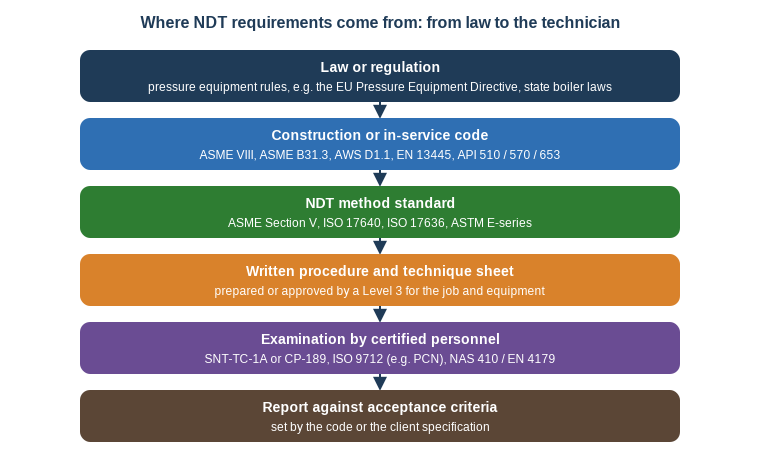
- Law or regulation. Many countries make pressure equipment, lifting equipment, pipelines, aircraft and nuclear plant subject to law. The law either names codes directly or sets safety requirements that recognised codes meet. The EU Pressure Equipment Directive and US state boiler and pressure vessel laws are examples.
- Construction or in-service code. The code for the product says which welds or areas need NDT, which methods, how much of them, and what is acceptable: for example ASME Section VIII for vessels, ASME B31.3 for process piping, AWS D1.1 for structural steel, EN 13445 in Europe, or API 510, 570 and 653 for equipment in service.
- NDT method standard. The code calls up a standard that describes each method: ASME Section V, ISO standards such as ISO 17640 for UT of welds, or ASTM E-series standards.
- Written procedure. The employer's procedure, prepared or approved by a Level 3, turns the code and method standard into instructions for a particular product and equipment, often with a technique sheet or scan plan for each job.
- Examination. Certified personnel carry out the test, to the procedure.
- Report. Results are recorded and compared with the acceptance criteria of the code or client specification.
Client specifications sit alongside this chain and often add to the code: more NDT, stricter acceptance, specific techniques or extra certifications.
When is NDT required?
NDT is required when the governing code, regulation or contract says so, and to the extent it says. Some typical cases:
- New pressure vessels: the construction code links the extent of radiography or ultrasonic testing to the joint type and the joint efficiency used in the design; full examination allows a higher design efficiency.
- Process piping: ASME B31.3 sets a minimum random examination for normal fluid service and more for severe cyclic and high-pressure service.
- Structural steel: AWS D1.1 and EN 1090-2 make visual inspection standard and leave the extent of other NDT largely to the contract documents and, in Europe, to the execution class.
- Equipment in service: inspection codes such as API 510, 570 and 653, or risk-based inspection plans, set inspection intervals and methods.
- Aerospace: engineering drawings and specifications name the method and area for each part, and maintenance manuals set in-service checks.
- Repairs and alterations: usually need the same NDT as original construction, as set out by the in-service code.
The organisations and their key documents
ASNT (American Society for Nondestructive Testing)
The professional society for NDT. Its key documents are about people: Recommended Practice SNT-TC-1A, the guideline most North American employers use to write their own certification programme; ANSI/ASNT CP-189, a stricter standard for the same purpose; and CP-105, the topical outlines for training. ASNT also runs its own central certifications, ASNT NDT Level II and Level III, and publishes handbooks and the journal Materials Evaluation.
ASTM International
Committee E07 on Nondestructive Testing writes most of the North American NDT method standards. Examples: E164 (contact UT of weldments), E114 (straight-beam contact UT), E797 (thickness measurement by UT), E2700 (phased array UT of welds), E2373 (TOFD), E1417 (penetrant testing), E1444 and E709 (magnetic particle testing), E94 and E1742 (radiography), E1004 and E376 (eddy current conductivity and coating thickness), E1316 (NDT terminology) and E543 (agencies performing NDT). ASME adopts many of them.
ASME (American Society of Mechanical Engineers)
The construction codes (Boiler and Pressure Vessel Code sections, B31 piping codes) say where and how much NDT is needed and what is acceptable. Section V contains the NDT methods they call up: general requirements (Article 1), radiography (Article 2), ultrasonic testing of welds and of materials (Articles 4 and 5), penetrant (Article 6), magnetic particle (Article 7), eddy current of tubes (Article 8), visual (Article 9), leak testing (Article 10), and articles on acoustic emission, alternating current field measurement, magnetic flux leakage, remote field and other techniques; a second part reprints the ASTM standards ASME has adopted. Section XI covers in-service inspection of nuclear plant components.
API (American Petroleum Institute)
The in-service inspection codes API 510 (pressure vessels), API 570 (piping) and API 653 (tanks), with their recommended practices, govern inspection in refineries and petrochemical plants. API 1104 covers pipeline welding and its NDT. API also certifies inspectors and runs performance-demonstration certifications for UT examiners, such as QUTE (thickness measurement), QUSE (shear wave flaw detection and sizing) and QUPA (phased array). See our API 570 course notes.
AWS (American Welding Society)
AWS D1.1 and the other D1 codes include requirements for visual inspection and for radiographic and ultrasonic testing of welds, with their own UT technique and acceptance tables. AWS B1.10 and B1.11 are guides to the NDE and visual inspection of welds, and QC1 governs the Certified Welding Inspector (CWI) scheme.
Aerospace bodies
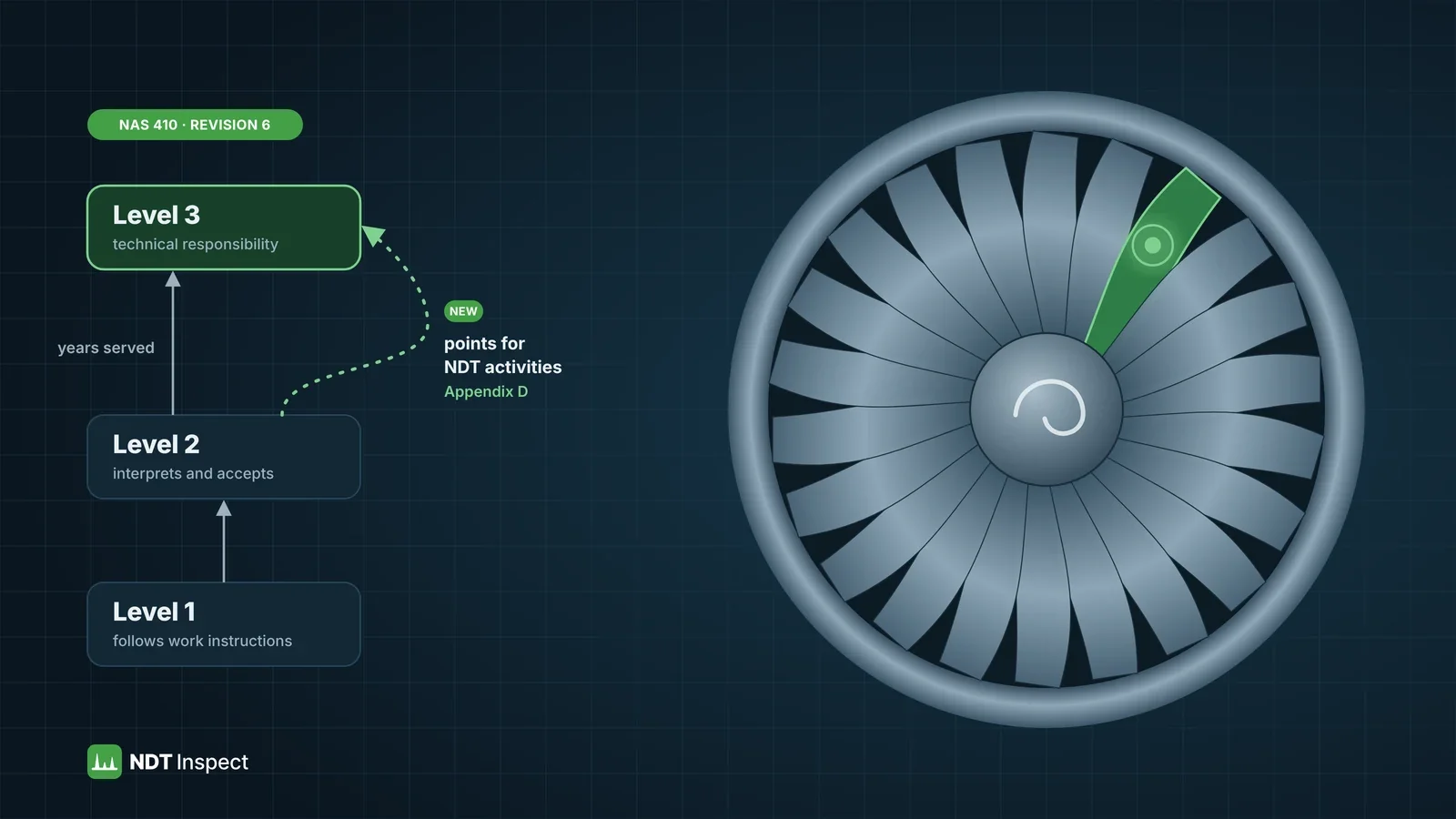
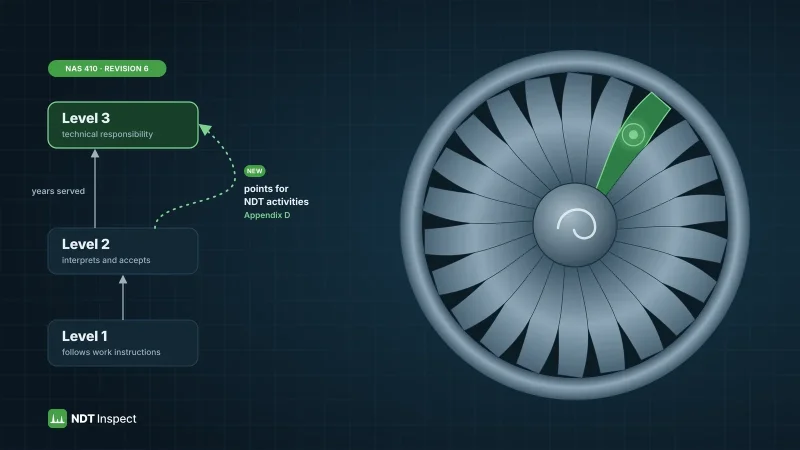
NAS 410, published by the Aerospace Industries Association, and its European equivalent EN 4179 set the certification requirements for NDT personnel in aerospace, usually with a National Aerospace NDT Board or a company Level 3 overseeing them. Method practices such as ASTM E1417 and E1444, SAE specifications, and the aircraft and engine makers' own specifications apply to the work itself, and the Nadcap programme audits and accredits NDT suppliers.
National Board of Boiler and Pressure Vessel Inspectors
The US and Canadian body of jurisdictional authorities. It commissions inspectors who verify ASME code work, including Authorized Inspectors and Authorized Nuclear Inspectors, and publishes the National Board Inspection Code (NBIC) for in-service inspection, repair and alteration of boilers and pressure vessels.
ISO (International Organization for Standardization)
Technical committee ISO/TC 135 writes the international NDT standards: ISO 9712 for personnel certification, general principles for each method (for example the ISO 16810 series for UT, ISO 3452 for penetrant, ISO 9934 for magnetic particle, ISO 15549 for eddy current), and the standards for testing welds and their acceptance levels (ISO 17635 to 17640, ISO 11666, ISO 10675, ISO 23277, ISO 23278, ISO 13588 and ISO 10863).
CEN and the European Pressure Equipment Directive
CEN publishes European standards, most NDT ones identical to ISO and numbered EN ISO. The Pressure Equipment Directive (2014/68/EU) sets the essential safety requirements for pressure equipment sold in the EU; among them, NDT personnel testing permanent joints in the higher-risk categories (III and IV) must be approved by a recognised third-party organisation. Harmonised standards such as EN 13445 and EN 13480 give a presumption of conformity.
National societies and certification bodies
Many countries have their own NDT society and central certification scheme, usually to ISO 9712: BINDT and its PCN scheme in the UK, Natural Resources Canada with CINDE in Canada, DGZfP in Germany, COFREND in France, AINDT in Australia, JSNDI in Japan and ISNT in India, among others. See our list of NDT institutions and societies worldwide.
Military and government
Defence work has its own documents, such as US Navy MIL-STD-2035 for NDT acceptance criteria, and regulators in nuclear power, aviation and pipelines add their own requirements on top of the industry codes.
Personnel certification compared
| Scheme | Who certifies | Where it is used | Notes |
|---|---|---|---|
| ASNT SNT-TC-1A | The employer, to its own written practice | North America and worldwide | A recommended practice; certification ends when the person leaves the employer |
| ANSI/ASNT CP-189 | The employer | Where a code or client asks for it | A standard with stricter, mandatory requirements |
| ASNT NDT Level II and Level III | ASNT (central) | Worldwide | Portable between employers; employers still authorise the work |
| ISO 9712 (e.g. PCN, CGSB) | An independent certification body (central) | Europe, Canada and many other countries | Portable, recognised across employers and borders; the employer still authorises the work |
| NAS 410 / EN 4179 | The employer, with national board or Level 3 oversight | Aerospace | Stricter training, experience and vision requirements |
| API QUTE, QUSE, QUPA | API (performance demonstration) | Refining and petrochemical plants | An extra, hands-on test of UT skill; not a replacement for method certification |
Which one is needed is set by the code and the client. A common question is whether an ASNT Level III can stand in for an API QUTE or QUSE: they measure different things. Level III certification shows knowledge of a method and the authority to write procedures and certify others; QUTE and QUSE are practical tests of one person's thickness measurement or flaw detection and sizing on test pieces. Where an owner's inspection programme or specification requires QUTE or QUSE for examiners, a Level III certificate does not replace it unless the owner agrees in writing.
The ISO 9712 and SNT-TC-1A hours calculators and the recertification date calculator help with the numbers; how to become an NDT technician and the Level 3 role explain the career path.
Reference standards (calibration blocks)
In NDT, "reference standard" usually means a physical piece, not a document: a block or sample with known features used to set up and check the equipment. Examples are the IIW and miniature calibration blocks for UT (ISO 2400 and ISO 7963), basic calibration blocks with side-drilled holes under ASME Section V, flat-bottom hole blocks (ASTM E127 and E428), notched blocks for eddy current, tube standards for tube inspection, image quality indicators for radiography, and penetrant and magnetic particle test pieces. The code or method standard specifies which reference standard to use and how it must be made and certified. Chapter 5 of the UT handbook explains how UT blocks are used.
How to read a code requirement
- Check the edition and addenda named in the contract. Requirements change between editions, and the contract edition applies even if a newer one exists.
- Mandatory or not. "Shall" is a requirement; "should" is a recommendation. Mandatory appendices are part of the code; non-mandatory appendices are guidance.
- Follow the references. A code often calls up another document for a method or an acceptance standard; the referenced edition matters too.
- Code cases and interpretations. ASME and other bodies publish code cases (approved alternatives) and interpretations (official answers to questions). They are useful, but a code case only applies when the user chooses it and it is accepted.
- Client specifications can add to the code but should not lower its requirements.
- When in doubt, ask in writing: the Level 3, the inspector, the client's engineer or the code body.
Discuss specific requirements in the codes and standards group.
Frequently asked questions
What is the difference between an NDT code and an NDT standard?
A code is a complete set of rules for a type of product, including where NDT is needed and what is acceptable. A standard describes one task, such as how to carry out an ultrasonic test or how to certify personnel. Codes call up standards.
Which standard is used for NDT personnel certification?
ASNT SNT-TC-1A or ANSI/ASNT CP-189 for employer-based certification, mainly in North America; ISO 9712 for central certification internationally (for example PCN in the UK); NAS 410 or EN 4179 in aerospace. The code or client specification decides.
Is ASME Section V a code or a standard?
It is part of the ASME Boiler and Pressure Vessel Code, but it works like a set of method standards: it describes how to carry out each NDT method when another ASME code section requires it. Acceptance criteria are mostly in the construction code that calls it up.
Are ISO and EN NDT standards the same?
Most European NDT standards are ISO standards adopted unchanged and numbered EN ISO; in the UK they carry the prefix BS EN ISO. A few European standards have no ISO equivalent.
Who decides which NDT code applies to a job?
The law or regulation for the type of equipment, then the contract and client specification, which name the construction or in-service code and its edition. The NDT company's Level 3 then writes procedures to meet it.

















0 comments
Sign in to join the discussion.