
Welcome to NDT Inspect's phased array ultrasonics (PAUT) group, a place for professionals to connect and discuss the latest techniques and technologies in phased array ultrasonic inspection. PAUT is a non-destructive testing method that uses a phased array ultrasonic probe to inspect the condition of components such as pipelines, tanks, and pressure vessels. The probe consists of a number of individual ultrasonic elements that can be activated independently, allowing the direction and focus of the ultrasonic waves to be controlled in real-time. Our member group offers a platform for sharing knowledge and best practices on PAUT and its applications in various industries. Join our community of experts from around the world and be a part of the conversation on advancing the practice of phased array ultrasonic inspection.
Updates
-
 ashoo started the discussion PAUT and TofD2 years ago
Hello everyone
I'm Ashoo Yadav Advance NDT inspector.
I am currently looking for a job, if there is please let me know or suggest any good portal or company.
👍4 -
 Chris posted an update in the group Phased Array Ultrasonics (PAUT)2 years ago
Amine Service Cracking in Heat-Affected Zone
This image from Phased Array Ultrasonic Testing (PAUT) showcases the detection of amine service cracking in the heat-affected zone (HAZ) adjacent to a weld. Unlike common weld cracks, these are specifically due to the corrosive effects of amine solutions in the HAZ. The PAUT image reveals linear indications characteristic of stress corrosion cracking that occurs in environments involving amine-based chemicals. This type of cracking is particularly concerning because it can compromise the integrity of the structure in areas not typically subjected to the same scrutiny as welds themselves. This finding highlights the importance of inspecting the HAZ in amine service environments for early detection and prevention of such defects.
 👍1
👍1 -
 Doug posted an update in the group Phased Array Ultrasonics (PAUT)2 years ago
-
Doug posted an update in the group Phased Array Ultrasonics (PAUT)2 years ago

-
Doug posted an update in the group Phased Array Ultrasonics (PAUT)2 years ago
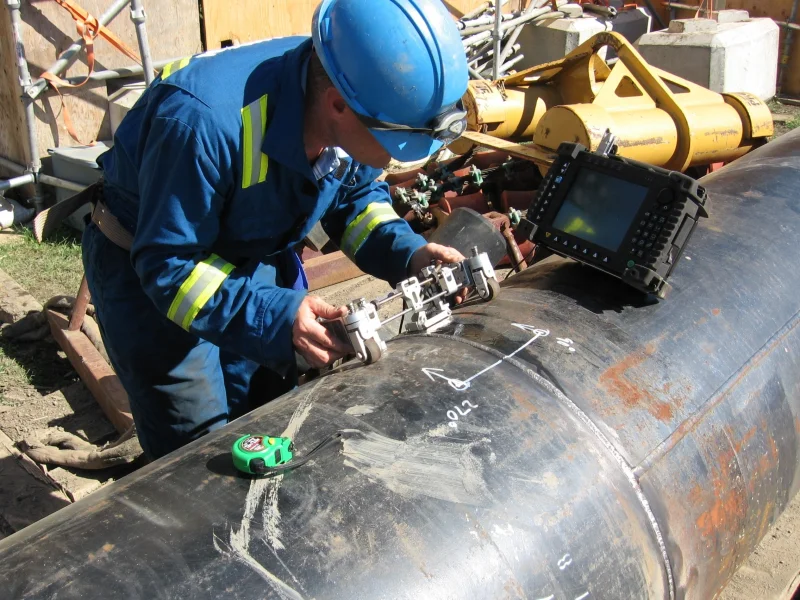
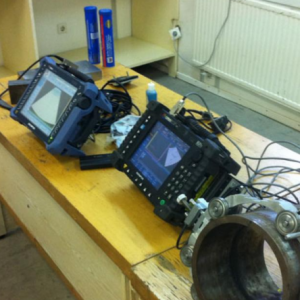
These images capture the intricate process of Phased Array Ultrasonic Testing (PAUT) being conducted on a pipe weld. PAUT is a sophisticated non-destructive testing technique that utilizes multiple ultrasonic elements and time delays to create beams that can be steered, scanned, swept, and focused electronically. This advanced method provides a detailed inspection of welds, enabling technicians to detect flaws with precision and accuracy. The image showcases the meticulous attention and technical expertise required in performing PAUT, reflecting the commitment to ensuring the highest standards of safety and quality in industrial maintenance.
👍2 -
 NDT-Inspect posted an update in the group Phased Array Ultrasonics (PAUT)3 years ago
Phased Array Ultrasonics: A Comprehensive InsightIntroduction
Phased Array Ultrasonics (PA) is a cutting-edge technology that has transformed the way we approach ultrasonic testing. Utilized in various fields, from medical diagnostics to industrial inspections, PA offers a versatile and efficient method for examining structures and detecting flaws. This article delves into the principles, applications, advantages, challenges, and future prospects of Phased Array Ultrasonics.
Section I: Principles of Phased Array Ultrasonics1.1 Basic ConceptPhased Array Ultrasonics operates on the principle of wave physics. It involves the use of multiple small ultrasonic transducers, each capable of being pulsed independently. By controlling the timing of these pulses, a focused and steerable ultrasonic beam is created.
1.2 Beam Steering and FocusingThe beam's direction and focus can be electronically controlled by adjusting the time delays between the pulses. This allows for precise targeting and sweeping of the beam across the object being examined.
1.3 Image FormationThe data from multiple beams are combined to create a visual image, showing a slice through the object. This imaging capability enhances the understanding and interpretation of the underlying structures.
Section II: Applications of Phased Array Ultrasonics2.1 Medical Imaging- Heart Examination: Noninvasive examination of the heart's structure and function.
- Ultrasound Imaging: Used in various medical diagnostics, including prenatal care.
- Construction: Ensuring structural integrity.
- Pipelines: Inspection of welds and detection of flaws.
- Power Generation: Quality control in power plants.
- Corrosion Inspection: Wall thickness measurements and corrosion detection.
The ability to electronically steer and focus the beam provides unparalleled precision and flexibility in examination.
3.2 EfficiencyPA's controllable parameters make it highly efficient in detecting defects, speeding up the testing process.
3.3 Enhanced VisualizationThe visual imaging capability offers a clear understanding of the underlying structures, aiding in accurate interpretation.
3.4 VersatilityIts applications span across various sectors, making it a versatile tool for different testing needs.
Section IV: Challenges and Limitations4.1 ComplexityPA instruments are more complex compared to conventional methods, requiring specialized training and experience.
4.2 CostThe complexity of the technology translates to higher costs, making it a significant investment.
4.3 Technological LimitationsCertain limitations in beam control and imaging resolution may affect the accuracy in specific applications.
Section V: Future Prospects and ConclusionPhased Array Ultrasonics is poised for further growth and innovation. With ongoing research and technological advancements, the future holds promising prospects for enhanced capabilities and broader applications.
The integration of artificial intelligence and machine learning may further refine the precision and efficiency of PA, opening new horizons in ultrasonic testing.
In conclusion, Phased Array Ultrasonics stands as a testament to the power of innovation in modern testing and imaging. Its principles, applications, and advantages make it a valuable asset in quality control and diagnostics. While challenges exist, the continuous pursuit of excellence ensures that PA remains at the forefront of technological advancement.
-
 andts posted an update in the group Phased Array Ultrasonics (PAUT)3 years ago
Type of defect? PAUT (See image below)

-
 3 years ago
Hi,
I have found this:
you determine both your a/l and your a/t for a given thickness. This will likely require linear interpolation(s). You then compare your a/t% to your a/l for that thickness. If your a/t% falls below the allowable a/t% for that thickness, the flaw is allowable.
General formula for interpolation:
http://www.ajdesigner.com/phpinterpolation/linear_interpolation_equation.php
Hope it helps.
-
 3 years ago
I'm having a discussion about the acceptability of indications by applying table 7.9 of ASME VIII Div.2.
There are two different opinions. It is not clear whether, in the event that a subsurface defect has a height lower than the value in the table and a length greater than 6.4 mm, the imperfection is acceptable or not.
In my opinion, to be unacceptable, both the height (a/t) and the length must exceed the values in the table and if it exceeds only the length, the limit is 4t.
Thanks to anyone who can help me. -
3 years ago
Phased array inspection can be performed on materials at high temperatures, although there are some limitations and considerations to keep in mind.
One of the main challenges of performing phased array inspection at high temperatures is the effect of temperature on the ultrasonic waves being used. At high temperatures, the ultrasonic wave velocity may be affected, leading to errors in the measurements. Additionally, the temperature of the material being inspected can affect the properties of the material itself, such as the attenuation and scattering of the ultrasonic waves.
To overcome these challenges, specialized probes and techniques may be required to ensure accurate and reliable results. For example, the use of cooled probes can help to minimize the effects of temperature on the ultrasonic waves. Additionally, the use of specialized software tools can help to compensate for the effects of temperature on the ultrasonic wave velocity and other material properties.
It is important to carefully evaluate the suitability of phased array inspection for high temperature applications, and to follow proper procedures and use calibrated equipment in order to obtain reliable results.
👍1 -
3 years ago
There are several different types of phased array ultrasonic probes, each of which is designed for a specific application or use. Some common types of phased array probes include:
Linear array probes: These probes have a linear arrangement of elements, which produce a line-shaped beam that is used to scan a surface. They are often used for inspections that require a wide field of view, such as weld inspection or corrosion mapping.
Sector array probes: These probes have a sector-shaped arrangement of elements, which produce a sector-shaped beam that is used to scan curved or angled surfaces. They are often used for inspections that require a focused, directional beam, such as thickness measurements or flaw detection.
Focused probes: These probes have a single element or a small group of elements that produce a highly focused, directional beam. They are often used for inspections that require a high level of resolution and penetration, such as weld inspection or material characterization.
Dual-element probes: These probes have two elements that are arranged in a way that allows them to produce both a linear and a focused beam. They are often used for inspections that require both a wide field of view and a high level of resolution, such as corrosion mapping or flaw detection.
Multiplexed probes: These probes have a large number of elements that can be independently controlled to produce a variety of different beam shapes and angles. They are often used for complex inspections that require a high degree of flexibility, such as structural health monitoring or material characterization.
👍1 -
NDT-Inspect started the discussion Best probe for phased array inspection of thick welds in the forum Phased Array3 years ago
The best probe for phased array inspection of thick welds will depend on a number of factors, including the thickness of the weld, the material being welded, and the specific requirements of the inspection. In general, however, it is important to choose a probe with a high frequency and a small footprint, as this will provide the best resolution and penetration for thick welds. Some common probes that are often used for phased array inspection of thick welds include:
2D linear array probes: These probes are designed for inspecting large areas and have a rectangular or square shape. They are often used for weld inspection, as they provide good resolution and penetration, and can be used with a variety of different scanners and wedges.
2D phased array probes: These probes are similar to linear array probes, but they use multiple elements to produce a phased array beam, which provides improved resolution and penetration. They are often used for inspecting thick welds, as they can provide a clear, detailed image of the weld even at high thicknesses.
Sector array probes: These probes are shaped like a sector of a circle and are used for inspecting curved or angled surfaces. They are often used for weld inspection, as they provide good resolution and penetration and can be used with a variety of different scanners and wedges.
Focused probes: These probes are designed to produce a focused, highly directional beam that provides improved resolution and penetration. They are often used for inspecting thick welds, as they can provide a clear, detailed image of the weld even at high thicknesses.
-
3 years ago
PAUT, or phased array ultrasonic testing, is a non-destructive testing method that uses ultrasonic waves to detect defects or inconsistencies in materials. It is commonly used to inspect metals, but it can also be used on certain types of plastics. In general, plastics that are homogeneous and have a consistent thickness can be inspected using PAUT.
However, the technique may not be effective on plastics with complex shapes or varying thicknesses. To determine whether PAUT can be used to inspect a specific type of plastic, it is best to consult with a qualified engineer or technician who has experience with this testing method.
-
3 years ago
A phased array technique sheet is a document that provides detailed instructions for performing a phased array ultrasonic testing (PAUT) procedure. The technique sheet typically includes information about the test specimen, the test location, the test equipment, and the test parameters that should be used for the specific application.
The technique sheet may also include detailed instructions for setting up the phased array ultrasonic testing equipment, preparing the test specimen, and performing the ultrasonic scan. It may also provide guidance on how to analyze the data collected during the scan and generate a report documenting the results of the test.
Phased array technique sheets are commonly used by operators of phased array ultrasonic testing equipment to ensure that the test is performed correctly and consistently. The technique sheet provides a step-by-step guide to the testing process, allowing the operator to follow the instructions carefully and ensure that the test is performed accurately and reliably.
In addition to providing detailed instructions for performing the phased array ultrasonic test, the technique sheet may also include information about the limitations and limitations of the test, as well as any potential safety hazards that may be associated with the test. This information can help the operator to understand the capabilities and limitations of the phased array ultrasonic testing equipment, and to take appropriate precautions to ensure the safety of the operator and others in the vicinity.
-
Douglas started the discussion Phased Array Ultrasonics advantages over Radiography in the forum Phased Array3 years ago
Phased array ultrasonics is a type of non-destructive testing (NDT) that uses focused beams of ultrasonic energy to inspect materials, components, and systems. This method is considered to be more advanced and versatile than traditional ultrasonic testing methods, and it offers a number of advantages over other NDT methods, such as radiography.
One of the key advantages of phased array ultrasonics over radiography is its ability to provide real-time imaging. Radiography uses X-rays or gamma rays to produce images of the internal structure of an object, but the process is slow and requires the use of film or other imaging media to capture the images. In contrast, phased array ultrasonics uses specialized equipment to generate and detect ultrasonic waves, and the resulting images can be displayed on a screen in real time. This allows for faster and more efficient inspection, and it also allows for the use of digital imaging techniques to enhance and analyze the images.
Another advantage of phased array ultrasonics over radiography is its ability to detect and size small defects. Radiography is capable of detecting relatively small defects, but it is not as sensitive as phased array ultrasonics, which can detect very small defects with high accuracy. This makes phased array ultrasonics particularly useful in the inspection of critical components and structures, where small defects can be a safety concern.
Phased array ultrasonics is also safer and more environmentally friendly than radiography. Radiography uses ionizing radiation, which can be hazardous to both operators and the environment if not used properly. In contrast, phased array ultrasonics uses non-ionizing ultrasonic waves, which do not pose any health or environmental risks. This makes phased array ultrasonics a safer and more sustainable choice for NDT.
In addition to these advantages, phased array ultrasonics also offers greater flexibility and versatility than radiography. Phased array ultrasonics can be used to inspect a wide range of materials, including metals, composites, ceramics, and plastics, whereas radiography is limited to certain types of materials. Phased array ultrasonics can also be used to inspect complex geometries and irregular shapes, whereas radiography is limited to relatively simple shapes.
Overall, phased array ultrasonics offers a number of advantages over radiography, including real-time imaging, the ability to detect small defects, safety and environmental friendliness, and flexibility and versatility. These advantages make phased array ultrasonics a valuable tool for ensuring the integrity and safety of critical components and structures in a variety of industries.
Discussions