








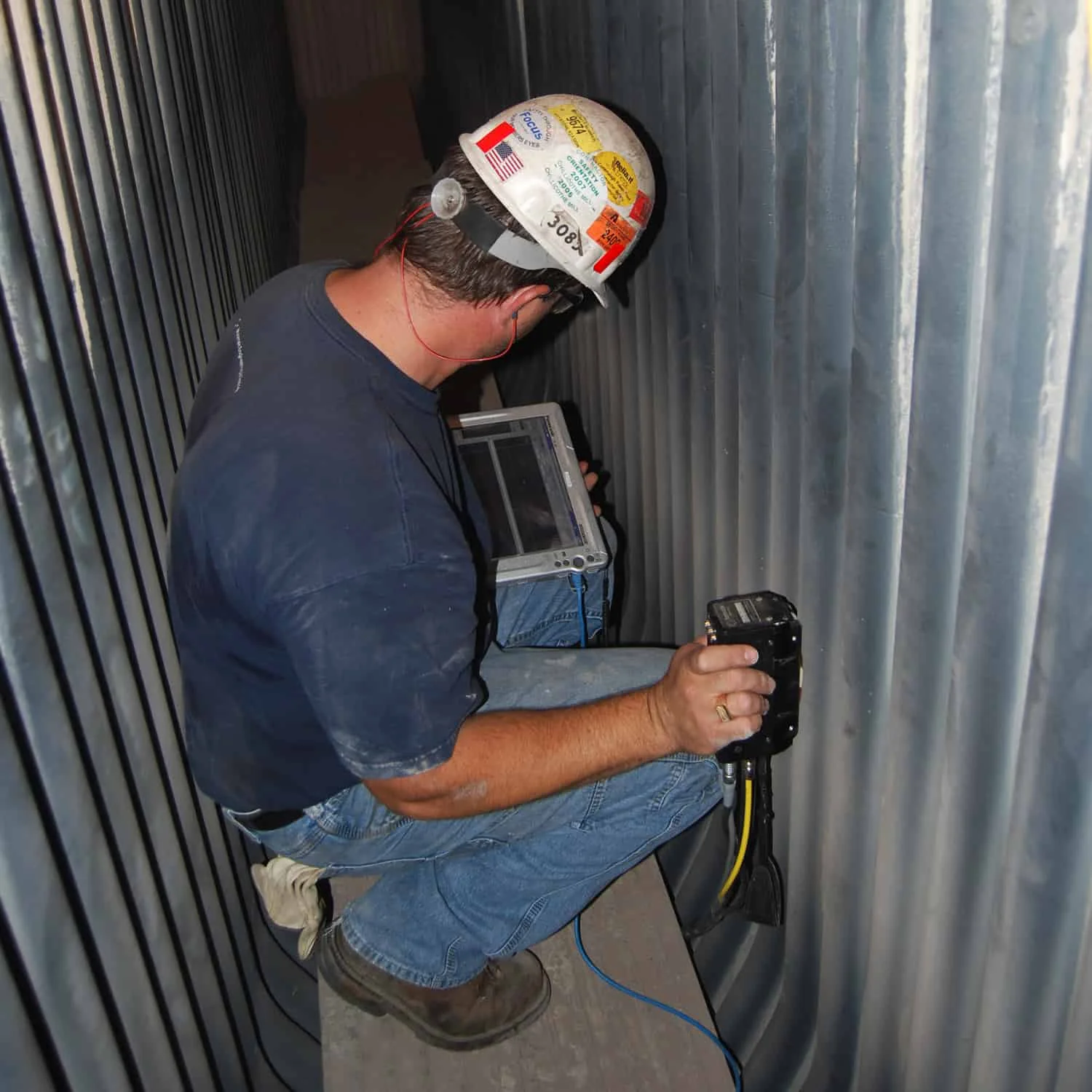
Levels, hours and the road to Level 3
What is the difference between NDT Level 1, Level 2 and Level 3?
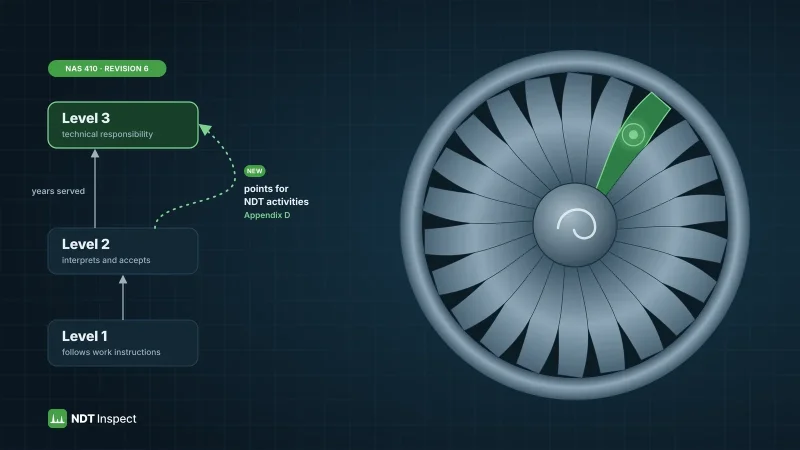
A Level 1 carries out tests to written instructions under supervision. A Level 2 sets up and calibrates the equipment, interprets results against the code and signs the report, and a Level 3 writes and approves procedures, chooses the technique, interprets codes and examines the people below.
Levels are held per method: you can be Level 2 in UT and Level 1 in RT. Below Level 1 is the trainee, who logs hours under supervision and signs nothing.
| Task | Level 1 | Level 2 | Level 3 |
|---|---|---|---|
| Set up and calibrate the equipment | Yes, to a written instruction | Yes | Yes |
| Interpret results against the code | Limited (see below) | Yes | Yes |
| Sign the accept or reject report | Rarely | Yes | Yes |
| Write job instructions from a procedure | No | Yes | Yes |
| Write and approve procedures, choose the technique | No | No | Yes |
| Train and supervise trainees and Level 1s | No | Yes | Yes |
| Set and mark certification exams | No | No | Yes |
The schemes differ at Level 1. SNT-TC-1A lets a Level I make specific accept or reject calls where written instructions give the criteria; ISO 9712 lets a Level 1 record and classify results but not take responsibility for interpreting them. Most clients want a Level 2 signature on every report, and the contract specification says which level signs.
Level 3 is a different job, not a senior Level 2. For work and pay by level, see NDT jobs at Level 1, 2 and 3 and the vacancies for trainees, Level 1, Level 2 and Level 3.
How many training and experience hours do I need for NDT Level 2?
Hours are counted per method. For UT Level 2 with no Level 1 first, SNT-TC-1A recommends 80 hours of training and 840 hours of UT work within 1,600 hours of NDT work, while ISO 9712:2021 requires 18 training days and 180 days of UT experience; PT and MT need a few days of training and about 10 to 13 weeks of full-time work.
Figures are for direct entry, with no Level 1 first: the Level 1 and Level 2 rows added together.
| Method | SNT-TC-1A training | SNT-TC-1A work: in method / all NDT | ISO 9712:2021 training | ISO 9712:2021 experience in method |
|---|---|---|---|---|
| UT | 80 h | 840 h / 1,600 h | 18 days (126 h) | 180 days (1,260 h) |
| RT | 80 h | 840 h / 1,600 h | 15 days (105 h) | 180 days (1,260 h) |
| MT | 20 h | 280 h / 530 h | 5 days (35 h) | 60 days (420 h) |
| PT | 12 h | 210 h / 400 h | 5 days (35 h) | 60 days (420 h) |
- Per method. UT hours do not count towards RT. SNT-TC-1A also counts all NDT work, and you must meet both columns.
- SNT-TC-1A figures are recommendations. The employer's written practice sets the binding numbers, and a contract can raise them.
- ISO 9712 figures are minimums, checked before the exam. A day is 7 hours, which can be built up across days. The 2012 edition counted months (UT Level 2: 3 + 9), still widely quoted.
- Already Level 1? For UT you then need 40 hours of training and 630 hours of UT within 1,200 of NDT (SNT-TC-1A), or 10 training days and 135 days of experience (ISO 9712).
- Radiography adds radiation safety training and often a licence: see the radiographic testing questions.
Then come general, specific and practical exams: SNT-TC-1A recommends 70% in each and 80% on average, and ISO 9712 needs 70% in each part.
Worked example. A trainee works 40 hours a week, 20 on UT, aiming for UT Level 2 by direct entry.
- SNT-TC-1A, UT hours: 840 ÷ 20 = 42 weeks.
- SNT-TC-1A, all NDT hours: 1,600 ÷ 40 = 40 weeks.
- The longer governs: about 42 weeks (10 months), plus 80 hours of training.
- ISO 9712: 180 days × 7 h = 1,260 h of UT, and 1,260 ÷ 20 = 63 weeks, about 15 months.
Try it: SNT-TC-1A hours calculator
Try it: Exam composite grade calculator
How do I become an NDT Level 3?
Build several years of Level 2 work, then pass a basic exam (materials, manufacturing processes, the certification scheme and other NDT methods) and a method exam that tests code knowledge and procedure writing. In the US that usually means the ASNT NDT Level III; under ISO 9712 it means a Level 3 from a certification body such as PCN, CSWIP or ASNT 9712.
The ASNT NDT Level III is a personal certificate: the basic exam once, then a method exam per method, with an experience requirement that a science or engineering degree shortens. The certificate lasts five years and is renewed by points for continued activity or by re-examination. An employer working to SNT-TC-1A then certifies you as its Level III, and can accept the ASNT certificate in place of its own basic and method exams. CP-189 makes the ASNT NDT Level III compulsory for every Level III.
Under ISO 9712 the certification body sets a basic exam and a main-method exam that includes drafting a procedure. The experience needed beyond Level 2 is substantial, and a relevant degree can reduce it.
The basic paper catches most candidates out, with questions on welding, casting and heat treatment. For the full story read NDT Level 3: the role and how to get there, ask in the NDT Level III group, see the thread on studying for PCN UT Level 3, and browse Level 3 vacancies.
Next chapterSchemes: SNT-TC-1A, ISO 9712 and the restSchemes: SNT-TC-1A, ISO 9712 and the rest
SNT-TC-1A or ISO 9712: which NDT certification do I need?
You need the scheme named by the code and the client on the work you want. SNT-TC-1A (or CP-189) employer certification covers most US industry and ASME code work, while ISO 9712 central certification, through PCN, CSWIP and other national schemes, is the usual requirement in the UK, Europe, the Middle East and on many oil and gas contracts worldwide.
The difference is who certifies you. SNT-TC-1A is ASNT's recommended practice: each employer writes a written practice from it, its Level III runs the exams, and the employer certifies you. ISO 9712 is an international standard: an independent certification body examines you and issues the certificate in your name. The current ISO 9712:2021 is published in Europe as EN ISO 9712:2022 and in the US as ANSI/ASNT CP-9712; it replaced EN 473.
Who certifies you decides what happens to the certificate when you change jobs.
- US fabrication, refineries, power and ASME code work: an employer's written practice to SNT-TC-1A or CP-189.
- UK and Europe: ISO 9712. The Pressure Equipment Directive requires NDT personnel on category III and IV pressure equipment to be approved by a recognised third-party organisation, in practice central certification.
- Middle East, Asia and offshore: mostly ISO 9712, often "PCN or equivalent" in operator specifications; some clients accept SNT-TC-1A with conditions.
- Aerospace, in every country: NAS 410 or EN 4179.
Neither scheme is better. SNT-TC-1A asks whether this employer vouches for you; ISO 9712 asks whether an independent body has examined you. Check the vacancy and client specification before paying for a course. The forum thread on SNT-TC-1A and how to become an NDT technician cover both routes.
Is there such a thing as an ASNT Level II, and who issues my NDT certificate?
Usually "ASNT Level II" is shorthand for a Level II certified by an employer to ASNT's SNT-TC-1A, and that certificate is issued by the employer, not by ASNT. ASNT does issue a few personal certificates of its own: the ASNT NDT Level III, the newer ASNT NDT Level II, and ASNT 9712 at Level II and Level III, which follows ISO 9712.
- Employer certification to SNT-TC-1A. What most US Level IIs hold: a company document tied to the employer's written practice. ASNT keeps no record of it.
- ASNT NDT Level II. A personal ASNT certificate in MT, PT, RT, UT or VT, from ASNT's computer-based general and specific exams, with your experience signed off by a Level III. The practical exam and eye test still come from the employer, so it supports employer certification rather than replacing it.
- ASNT 9712. ASNT's ISO 9712 scheme at Level II and Level III, with practical exams at authorised centres. It has taken over from ACCP, the older ASNT Central Certification Program, whose certificates run on to their expiry dates.
A school's certificate of training is not SNT-TC-1A certification. In 2026 ASNT warned against training organisations issuing SNT-TC-1A certificates with no link to an employer's written practice, and against putting ASNT's name or logo on them. A school may train you and run exams for an employer, but only the employer certifies.
On a CV, write "UT Level II to SNT-TC-1A, certified by (employer), (year)" rather than "ASNT Level II", unless you hold the ASNT NDT Level II itself. Clients check.
What are CP-189, NAS 410 and EN 4179, and who uses them?
CP-189 is ASNT's employer-based standard: it works like SNT-TC-1A, but its minimums are mandatory and every Level III must hold the ASNT NDT Level III. NAS 410 (US) and EN 4179 (Europe) are the aerospace equivalents, harmonised with each other and required by aircraft, engine and component makers and their suppliers.
ANSI/ASNT CP-189 says "shall" where SNT-TC-1A says "should", and an employer cannot lower its requirements. It applies where a code or contract names it: ASME Section V lists it beside SNT-TC-1A, and the nuclear in-service inspection rules of ASME Section XI build on it. The certification still belongs to the employer.
NAS 410 and EN 4179 cover NDT on aircraft, engines and their parts. They are employer-based too, with a written practice and a responsible Level 3, but stricter than most industrial practice: exams on aerospace parts and specifications, practical exams again at recertification, and close audit by the prime contractors. In many European countries a National Aerospace NDT Board examines Level 3s or approves the outside agencies that do.
Industrial certification does not carry straight into aerospace: the aerospace employer will still train and examine you on its own parts and specifications. If you are planning that move, ask in the forum thread on aerospace PCN Level 3. For who writes which document, see NDT codes and standards.
CSWIP 3.1 vs 3.2 and CWI: what is the difference between a welding inspector and an NDT technician?
A welding inspector checks the whole welding job (procedures, welder qualifications, consumables, fit-up, visual inspection and records), while an NDT technician tests welds and parts with a method such as UT or RT; the two overlap only in visual inspection. CSWIP 3.1 is the Welding Inspector level, CSWIP 3.2 is Senior Welding Inspector, and AWS CWI is the US certificate broadly comparable to 3.1.
| Certificate | Issued by | What it covers |
|---|---|---|
| CSWIP 3.0 | TWI Certification | Visual Welding Inspector: visual inspection of welds to a procedure |
| CSWIP 3.1 | TWI Certification | Welding Inspector: before, during and after welding, documents, visual inspection |
| CSWIP 3.2.1 | TWI Certification | Senior Welding Inspector: supervising inspectors, inspection planning, reviewing NDT reports |
| CSWIP 3.2.2 | TWI Certification | 3.2.1 plus radiographic interpretation of welds |
| AWS CWI | American Welding Society | Certified Welding Inspector to AWS QC1, with CAWI below it and SCWI above |
CSWIP 3.2 normally follows about two years working as a 3.1 inspector. No CSWIP welding inspection certificate is an ISO 9712 NDT certificate: even the radiographic interpretation in 3.2.2 does not make you an RT Level 2. The CWI exam has three parts (fundamentals, a hands-on practical and a code book exam), each needing 72%, and the certificate runs on a nine-year cycle with renewals at three and six years.
Oil and gas adverts often ask for both, such as CSWIP 3.1 plus UT Level 2. A welding inspector reviews NDT reports and witnesses testing, but needs separate NDT certification to perform UT or RT. Visual testing qualification is covered on the visual inspection questions page, and acceptance standards on the weld acceptance criteria page.
Next chapterWill the certificate be accepted?Will the certificate be accepted?
Is ISO 9712 or PCN accepted on ASME and API work, and can an ASNT Level III replace API QUTE?
Where an ASME code calls up Section V, Article 1, NDT personnel must be certified by their employer to SNT-TC-1A or CP-189, so a PCN or other ISO 9712 holder can work once the employer certifies them under its written practice, or where the client accepts ISO 9712 in writing. An ASNT NDT Level III does not replace API QUTE: they test different things, and only the owner-user can waive a QUTE requirement.
ASME work. Section V, Article 1 makes the employer's written practice the governing document; the 2025 edition adopts the 2024 SNT-TC-1A and does not name ISO 9712. Two routes are common:
- The employer's written practice accepts the central certificate as evidence of training, experience and general knowledge, and the employer adds specific and practical exams on its procedures, an eye test and a certification letter.
- Where the client's specification governs qualification, the client accepts ISO 9712 as equivalent, in writing, before the job.
API work and QUTE. API 510 and API 570 call for UT shear-wave examiners who have passed a performance demonstration on certain applications, and many owner-users name API QUTE in turnaround specifications. QUTE sits on top of a UT Level 2: applicants need a current or previous UT Level II or above (ASNT, CGSB, PCN or another ISO 9712 scheme) and documented experience, then pass a hands-on test on welded specimens scored on missed flaws and false calls. It lasts three years, and renewal means the full test again. Versions exist for manual UT, phased array (QUTE (PA), called QUPA in older documents) and thickness measurement (QUTE-TM).
Level III in lieu of QUTE. An ASNT NDT Level III proves, by written exam, knowledge of the method and codes and the ability to write and approve a procedure. It says nothing about whether that person, probe in hand, finds the cracks in a blind test piece; QUTE proves exactly that. If the owner-user's specification requires QUTE, the contractor cannot substitute a Level III on its own authority; ask the owner-user in writing and file the reply. A common turnaround split is a Level III who approves the procedure and QUTE-qualified Level 2s who scan. Phased array and TOFD qualification is on the PAUT and TOFD questions page.
How do I verify an NDT certificate?
Check a central certificate with the body that issued it, check an ASNT NDT Level II or Level III on ASNT's certificate holder search, and check an employer certificate through that employer's Level III and records, because nobody else holds them.
- PCN: BINDT's online check takes the PCN number or the holder's surname.
- CSWIP: TWI Certification's online check needs the certificate number and the holder's date of birth.
- Other ISO 9712 bodies: each keeps a register of valid certificates and confirms one on request.
- ASNT, API and AWS: each runs a public look-up for the individual certificates it issues.
- SNT-TC-1A, CP-189 and NAS 410: ask the employer for the certification letter, the written practice it refers to, and the exam and eye-test records.
Check the method, level, sector or scope and expiry date, and ask for an eye test less than a year old. Red flags of a fake or worthless certificate:
- "Valid worldwide", "internationally accredited" or "lifetime" printed on it, or no expiry date.
- Level 2 or Level 3 after a short online course, with no record of experience.
- An SNT-TC-1A certificate from a training school with no employer named, or one carrying ASNT's logo.
- No method, level or sector stated, or an "ISO 9712" body that cannot show its accreditation.
- A number the issuer's register cannot find, or details that do not match the holder's ID.
If in doubt, contact the issuer through its official website, not the phone number or email printed on the certificate. CSWIP even publishes the names of people banned from holding its certificates.
Does my NDT certificate move with me to a new employer?
Employer certification under SNT-TC-1A, CP-189 or NAS 410 is issued by the employer and normally ends when you leave, so the new employer must certify you again. An ISO 9712 certificate stays valid and goes with you, but each new employer must still authorise you in writing to work on its procedures.
Under SNT-TC-1A, certification is treated as revoked when employment ends. What travels is the evidence: training certificates, your signed hours log, exam results, eye tests and any personal ASNT certificate. A new employer's Level III can use it to recertify you quickly, usually with specific and practical exams on its procedures.
Under ISO 9712 the certificate is yours, but two conditions follow it:
- Authorisation. The certificate shows general competence. The employer decides what you may do on its jobs, gives any job-specific training and records your authorisation.
- Continuity. At renewal, someone must confirm you kept working in the method. A break from the method of more than a year can invalidate the certificate.
When you change jobs:
- Before you leave, get signed copies of your certification letters, exam results and hours log, and keep your own log of work by method.
- For ISO 9712, keep the eye test current and make sure someone will be able to sign your renewal.
Agency contractors face this every few months, which is one reason many also hold a central certificate. The vacancy board shows what each employer asks for.
Next chapterCost, online study and staying validCost, online study and staying valid
How much does NDT certification cost, and can I get certified online?
The cost depends on the method, the level and the country: course fees, exam fees per method and level, re-sits, travel, and the months of supervised experience you can only get through a job. You can study the theory online, but practical training, the practical exam and the experience cannot be done online.
- Course length. PT and MT take a few days per level, UT and RT one to two weeks per level, so UT and RT cost several times as much.
- Exam fees, per method and level, plus re-sits. For example, ASNT listed its NDT Level II exam fee at USD 740 for members and USD 820 for non-members in November 2026.
- Experience. The largest cost, and nobody invoices it: months of logged work, which needs an employer.
- Extras: travel, radiation safety training for RT, eye tests, and renewal fees every five years.
In the US model the employer usually trains and certifies you in-house; check any training agreement for a fee-repayment clause. In central schemes many newcomers self-fund a first PT or MT course and the employer funds UT or RT later. The classic mistake is paying for a UT course with no job to log hours in: you finish and still cannot sit the exam. Look for trainee vacancies first.
SNT-TC-1A training can be online where the written practice accepts it, and some ISO 9712 training organisations offer blended courses. ASNT's written exams are taken at computer test centres. A provider offering "full certification online" with no practical exam and no experience check is selling a training certificate, not ISO 9712 or employer certification. Compare courses on the NDT schools and training providers page, and practise with mock exams and training simulators.
How do I keep my NDT certificate valid?
Pass a near-vision eye test every year, keep working in the method, and renew on time. ISO 9712 certificates are renewed every five years on evidence of continued work and recertified by examination every ten years, while SNT-TC-1A certification is renewed at intervals of up to five years by the method the employer's written practice sets.
Two clocks run at once: if the yearly eye test lapses, you are not qualified that day, whatever the certificate says.
| Certificate | Cycle | How it is renewed |
|---|---|---|
| ISO 9712 (PCN, CSWIP NDT, ASNT 9712) | Renewal at 5 years, recertification at 10 | Renewal: eye test and signed evidence of continued work without a significant break. Recertification: practical exam at Levels 1 and 2; exam or structured credit at Level 3. |
| SNT-TC-1A and CP-189 | Up to 5 years | Re-examination or evidence of continued satisfactory work, as the written practice or standard sets |
| ASNT NDT Level III | 5 years | Points for continued activity, or re-examination |
| API QUTE | 3 years | The full performance test again |
- Apply a few months before expiry: a late application can mean sitting the exams again.
- A long break from the method does not stop the clock, and may mean re-examination before you sign reports again.
- Reports signed after expiry are open to challenge, and a client audit will find them.
Try it: Recertification dates calculator
See all certification calculators, or ask about a scheme in the NDT certification and exams group.




















0 comments
Sign in to join the discussion.