








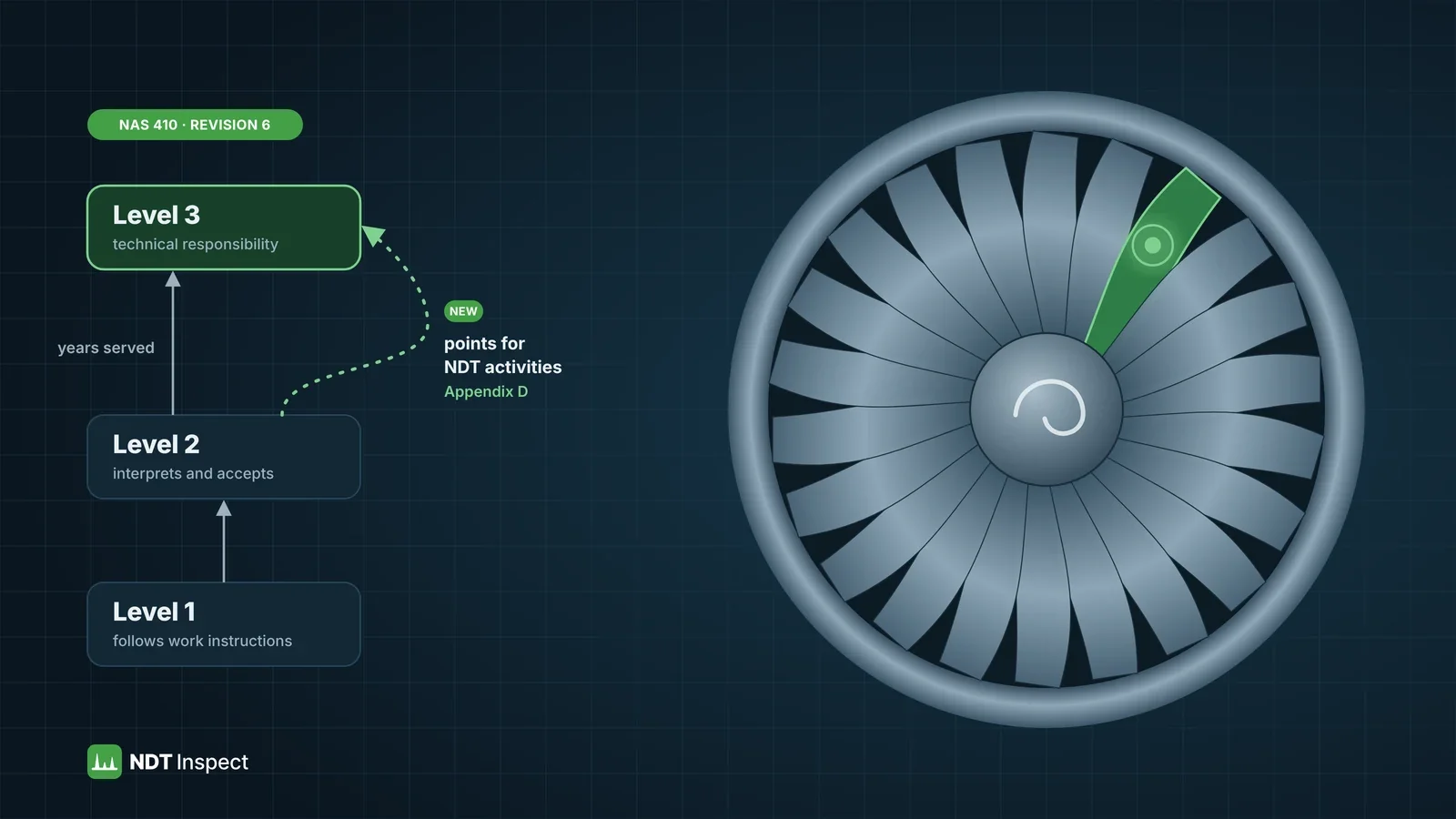
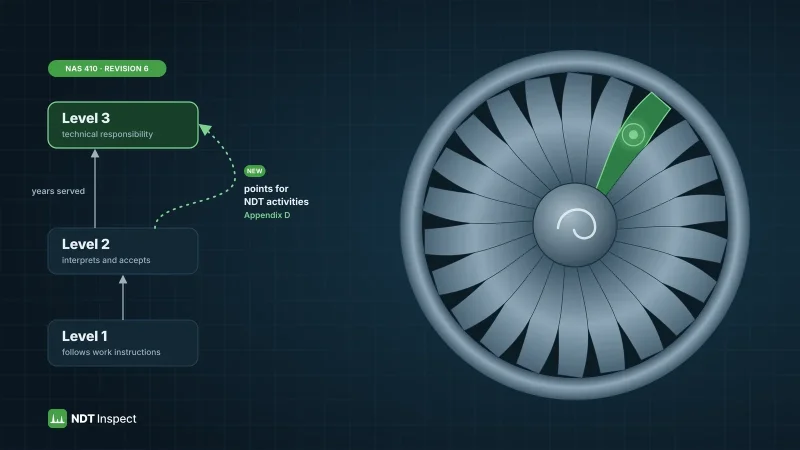
NAS 410 Revision 6, released by the Aerospace Industries Association (AIA) and Accuris on 1 December 2025, adds a second way for aerospace NDT technicians to become eligible for Level 3. A new Appendix D lets Level 2 personnel earn points for designated NDT activities. Once they hold the required points in each activity category, they may sit the initial Level 3 examinations. The existing time-served route stays in place, and so do the examinations. What changes is how a Level 2 demonstrates readiness to take them.
Key points
- Appendix D is an additional route to Level 3 eligibility. It does not replace the experience table.
- Points open the door to the examination. They do not replace the basic, method, specific and practical examinations.
- Certification still comes from the employer, under a written practice controlled by the Responsible Level 3.
- Employers need to compare their written practice with Revision 6 and decide how they will handle the new route.
What NAS 410 is, in thirty seconds
NAS 410 is the AIA standard that sets minimum requirements for qualifying and certifying people who perform NDT on aerospace hardware. The employer certifies each person, by method and by level, under a written practice. A Responsible Level 3, named by the employer, controls training, examinations and the practice itself. EN 4179 is the technically equivalent European standard. Nadcap auditors check an NDT supplier's written practice and personnel records against whichever of the two the supplier works to.
That makes it a different animal from the two schemes most technicians meet first:
| NAS 410 / EN 4179 | SNT-TC-1A | ISO 9712 | |
|---|---|---|---|
| Type of document | Standard with minimum requirements | Recommended practice the employer adapts | International standard |
| Who certifies | The employer | The employer | An independent certification body |
| Main sector | Aerospace manufacture and maintenance | General industry, strongest in North America | General industry worldwide |
| When you change jobs | Certification ends; the new employer certifies you again | Certification ends; the new employer certifies you again | The certificate stays with you |
What Revision 6 changed
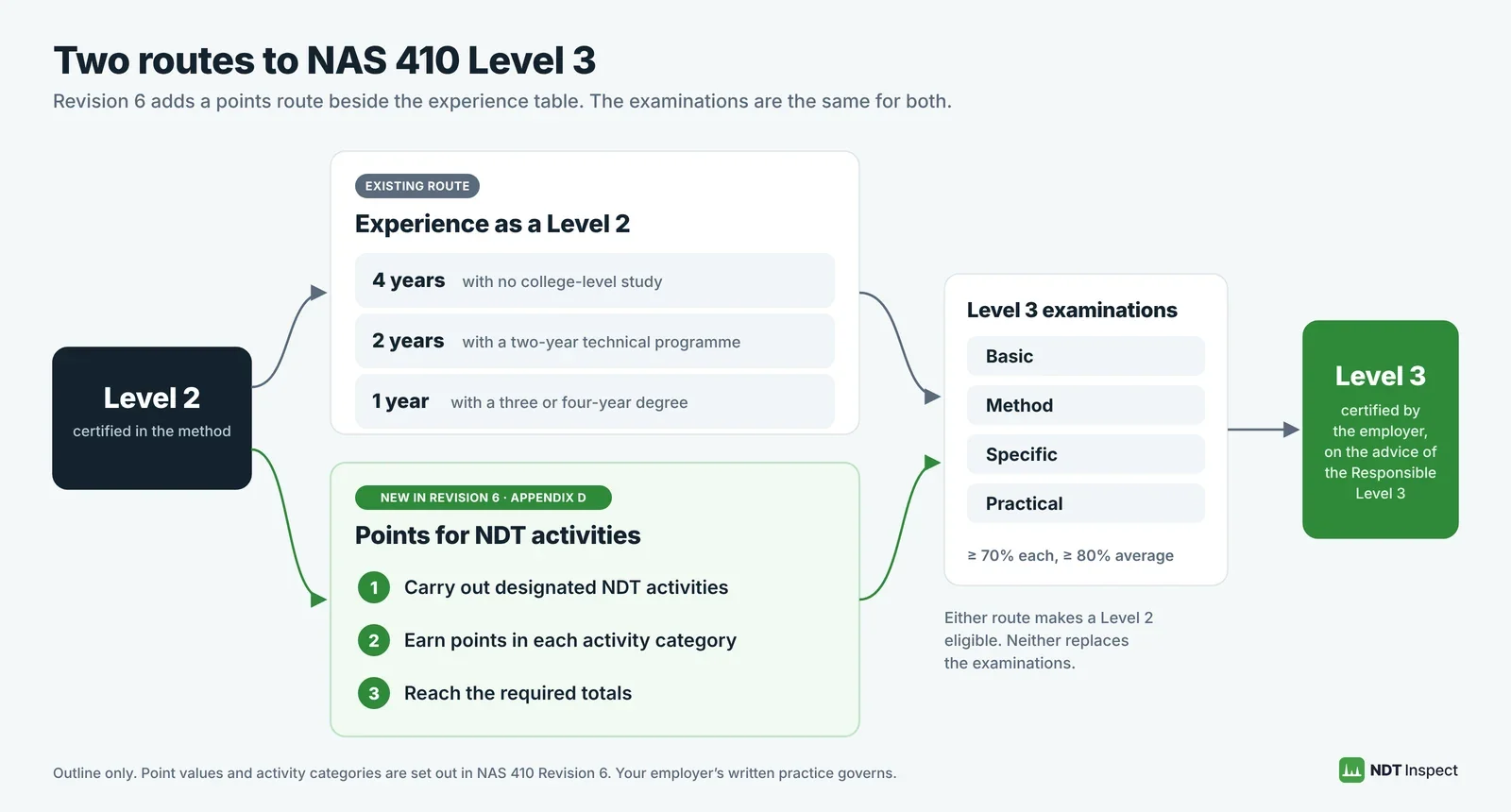
The headline change is Appendix D. As AIA describes it, the appendix sets up a second way to qualify for Level 3. A Level 2 collects points by carrying out NDT activities the standard designates, and when the totals required in every activity category are met, that person can take the initial Level 3 examination. Chris Carnahan, AIA's Assistant Vice President of Standards, described it as a competency-based credit system and said the revision also strengthens and clarifies certification requirements.
AIA's announcement does not itemise the other changes, and this article does not guess at them. The point values, the activity categories and the clause-by-clause edits are in the standard itself, which is sold through Accuris. AIA and Accuris ran a section-by-section webinar on the changes on 2 December 2025, and the recording is the best free summary available.
Revision 6 replaces Revision 5, which dated from 2020 and was amended twice. Published summaries of the new revision give an implementation deadline of no later than six months after the revision date, with certifications already held remaining valid until they expire. Confirm both points in your own copy, and check whether your customers have set dates of their own.
The route that already existed
Until now, eligibility for Level 3 rested on time served as a Level 2, reduced for formal education:
- four years as a Level 2 with no college-level study;
- two years with a two-year engineering or physical science programme;
- one year with a three- or four-year science or engineering degree.
A candidate who met the table then sat the Level 3 examinations: a basic examination covering other methods, materials and processes and the standard itself, a method examination, a specific examination on the employer's own procedures and specifications, and a practical. The usual pass marks are at least 70% on each examination and at least 80% on average. The composite examination grade calculator does that sum.
Revision 6 keeps this route.
What a points route changes in practice
Calendar time is a blunt measure. Four years at one bench running the same penetrant line on the same part family is not the same preparation as two years spread across procedure writing, technique development, audits and training. A points system recognises what a person has done, as well as how long they have been employed.
The people most likely to benefit are experienced Level 2s without a degree, and smaller suppliers that depend on a single outside Level 3 and need to grow their own.
Three things do not change:
- The examinations. Points make a candidate eligible. The examinations still decide whether they qualify.
- Who certifies. The employer does, on the recommendation of the Responsible Level 3.
- The audit trail. If anything, it gets heavier. Every activity claimed for points needs a record an auditor can follow.
What employers should do now
- Obtain Revision 6 and read it against your current written practice, clause by clause.
- Decide how the written practice will treat Appendix D, and check that your customers accept that position.
- If you adopt the points route, set up the record-keeping first: who signs off an activity, what evidence is kept and where.
- Check contract flow-down. Primes may set their own dates or add requirements.
- For European operations, confirm which edition of EN 4179 your national aerospace NDT board and customers are working to.
- Update training material and examination question banks that refer to the standard.
What Level 2 technicians should do now
Ask your Responsible Level 3 whether the company intends to use Appendix D, and which activities will count. Then start keeping your own log, with dates and evidence: techniques developed, work instructions drafted, trainees supervised, audits supported. A log is useful whichever route you end up taking.
One point to be clear on. An ASNT Level III certificate does not make you a NAS 410 Level 3. A written practice may give credit for it toward part of the examination, but the specific and practical examinations and the certification itself belong to the employer. Our guide to the Level 3 role and how to get there covers the wider picture.
The rest of the framework at a glance
| Item | Requirement in outline |
|---|---|
| Levels | Trainee, Level 1 Limited, Level 1, Level 2, Level 3. Instructor and auditor are designations, not levels |
| Examinations | General, specific and practical at each level; an additional basic examination for Level 3 |
| Vision | Near vision checked every year; colour perception at least every five years |
| Recertification | At intervals of no more than five years |
| Written practice | Controlled by the Responsible Level 3 named by the employer |
Training and experience hours vary by method and are set out in the standard's tables. The recertification due dates calculator helps keep the calendar side straight.
Is a points route lowering the bar?
Opinion in the trade is split, and both sides have a case.
The case for. Aerospace is short of Level 3s, and many of those in post are close to retirement. The time-based table held back capable people for reasons unrelated to competence. The examinations are unchanged, so the standard of the person who passes is unchanged.
The case against. Time in the job exposes a technician to the rare problems: the odd indication, the audit finding, the procedure that fails on a new part. Points can be collected quickly in a supportive shop, and a system that depends on the employer's own records is only as good as the employer.
Which way do you lean? If you hold Level 3 under NAS 410 or EN 4179, would a points log have got you there sooner, and would you have been ready? The Aerospace Sector group is open for that discussion.
NAS 410 Revision 6 FAQ
What is NAS 410?
NAS 410 is the Aerospace Industries Association standard for the qualification and certification of nondestructive testing personnel in the aerospace industry. It sets minimum training, experience, examination and vision requirements, and the employer certifies each person under a written practice.
What changed in NAS 410 Revision 6?
The main change is a new Appendix D, which adds a points-based route for Level 2 personnel to become eligible for the initial Level 3 examination. AIA also describes the revision as strengthening and clarifying certification requirements. Revision 6 was released on 1 December 2025.
Does Appendix D replace the Level 3 examinations?
No. Appendix D is a route to eligibility. Candidates who reach the required points still sit the Level 3 examinations and are certified by their employer.
Is NAS 410 the same as EN 4179?
They are technically equivalent standards, published separately in the United States and Europe and revised in step. European programmes often operate under a national aerospace NDT board, which the United States does not have.
Is an ASNT Level III enough for NAS 410 Level 3?
No. NAS 410 certification is issued by the employer. An ASNT Level III certificate may be credited toward part of the examination where the written practice allows, but the candidate must still meet the employer's specific and practical requirements.
Does NAS 410 apply outside aerospace?
It is written for aerospace manufacture, service, maintenance and overhaul. Other industries generally work to SNT-TC-1A, ANSI/ASNT CP-189 or ISO 9712.
The short version
Revision 6 gives Level 2 technicians a second route to the Level 3 examinations, based on what they have done as well as how long they have served. The examinations, the employer's role and the audit trail all remain. Employers have a written practice to review, and technicians have a good reason to start keeping a log.
Aerospace roles that ask for NAS 410 are posted on the NDT jobs board. For background, see NDT in aerospace maintenance and inspection and how to become a certified NDT technician.
Sources: Aerospace Industries Association, AIA and Accuris Release NAS410 Revision 6, 1 December 2025; NAS 410, Certification and Qualification of Nondestructive Test Personnel; EN 4179. This article reports what AIA has announced and summarises the framework in outline. It is not a substitute for the standard, and the requirements that bind you are those in your employer's written practice and your customers' contracts.














0 comments
Sign in to join the discussion.