









What’s new on NDT Inspect
Latest NDT & inspection industry news, jobs and community updates
Live updates from the NDT Inspect community: new NDT job vacancies, product launches from the virtual exhibition, forum discussions and member activity across ultrasonic, radiographic, phased array and every other inspection method. Join free to post and follow.
Members post updates, comment, react and follow the companies they work with. Already a member? Sign in
190 posts in DiscussionsClear
-
 Discussionjoss started the discussion ISO 17636 1 (2013) - Single wall technique / IQI film side / IQI selection in the forum NDT5 years ago
I can not find any table that tells me which wire IQI to use for single wall technique IQI film side either class A or B and also I cannot find any where it says that the film side IQI for single wall technique can not be used.
Thanks for any input on this point.
-
Discussionjoss started the discussion ISO 17636 1 (2013) - Single wall technique / IQI film side / IQI selection in the forum Codes and Standards5 years ago
I can not find any table that tells me which wire IQI to use for single wall technique IQI film side either class A or B and also I cannot find any where it says that the film side IQI for single wall technique can not be used.
Thanks for any input on this point. -
 Discussionchris started the discussion WORLWIDE NDT INSTITUTIONS AND SOCIETIES in the forum Codes and Standards5 years ago
Argentina
AAENDE
Asociación Argentina de Ensayos No Destructivos y, structurales, Altolaguirre 1674, CP C1431ECF Ciudad de Buenos Aires
Brazil
ABENDI
Associação Brasileira de Ensaios Não Destrutivos e Inspeção, Avenida Onze de Junho, 1.317, Vila Clementino, 04041-054 São Paulo-SP
Colombia
ACOSEND
Asociación Colombiana de Soldadura y Ensayos No Destructivos, Carrera 16 No. 57 - 22, Piso 2., Bogotá D.C.
Spain
AEND
Associacion Española de END, Calle Bocangel, 28 - 2° izda, E-28028 Madrid
Uruguay
AENDUR
Asociaciòn Uruguaya de Ensayos No Destructivos, Plaza Independencia, 812 piso 2, 11100 Montevideo
Australia
AINDT
Australian Institute for NDT, PO Box 52, Parkville, 3052 Victoria
Italy
AIPnD
Italian Society for NDT, Via A Foresti 5, 25127 Brescia
US
American Society for Nondestructive Testing (ASNT)
The American Society for Nondestructive Testing, Inc. (ASNT) is the world's largest technical society for nondestructive testing (NDT) professionals.
Moldova
AN NTD
National Society on NDT and Technical Diagnostics, 20 Meshterul Manole St, MD-2044 Kishinev
Romania
ARoENd
Romanian Association of NDT, 7 Soldanului St, Bloc 137, Sc A, Apt 4, Sector 4, CP 41-126 Bucharest Sector 1 042042 Bucharest
US
ASM International
Membership, career and technical information from the American Society of Metals
Venezuela
ASOVEND
Associacion Venezolana de Ensayos No Destructivos, Escuela de Ingeniería Metalurgica, Facultad de Ingeniería, Ciudad Universitaria (UCV), Entrada del Clínico, Paseo Los Ilustres, nivel Mezzanina, Caracas, Apatado Postal 47533
Australia
Australian Institute of NDT
Membership, events and general information from the Australian Institute of NDT
Indonesia
AUTRI
Indonesian Society for NDT (Asosiasi Uji Tak Rusak Indonesia)
c/o PATIR-BATAN, Jalan Lebak Bulus Raya 49, Pasar Jumat, 12440 Jakarta
Germany
BAM - Federal Institute of Materials Research and Testing, Germany
Federal Institute for Materials Research and Testing
Belarus
BANDT
Belarusian Association for NDT and Technical Diagnostic, Akademicheskaya 16, 220072 Minsk
Belgium
BANT
Belgian Association for NDT, Rue Lonhienne 14, B-4870 Trooz
Bulgaria
BGSNDT
Bulgarian Association for NDT, 6 Boncher Str, Bl 4 off 502, 113 Sofia
Bosnia and Herzegovina
Bosnian and Herzegovinan Society for NDT
Tvomicka 3, 71000 Sarajevo-Ilidza, BiH
UK
British Institute of Non-Destructive Testing
Organisation, membership, publications, events and employment opportunities
UK
British Society for Strain Measurement
Organisation, membership, training, diary, articles
Bangladesh
BSNDT
Bangladesh Society for NDT, c/o NDT Division, Atomic Energy Centre, 4 Kazi Nazrul Islam Avenue, Ramna, 1000 Dhaka
Canada
Canadian Institute for NDE
Code of Ethics, Executive and Board Directors, Members, Membership,Scholarship opportunities, the CSNDT Journal and Events
China
ChSNDT
Chinese Society for NDT, Floor 6, No 100 Huihe Road, 200437 Shanghai
Canada
CINDE
Canadian Institute for NDE, 135 Fennell Avenue West, Hamilton, L8N 3T2 Ontario
Czech Republic
CNDT
Czech Society for NDT, Technickà 2, CZ 616 69 Brno
France
COFREND
The French Institute of Non-Destructive Testing provides information, certification and regional groups.
Tunisia
COTEND
Tunisian Committee for NDT c/o CETIME, Z I Ksar Said, 2086 Douar Hicher Manouba
Croatia
CrSNDT
Croatian Society for NDT, Berislaviċeva 6, HR-10000 Zagreb
Algeria
CSC / FALEND
Centre de Recherche Scientifique et Technique en Soudage en Controle / Federation Algerienne des Essais Non Destructif, Route de Dely Ibrahim, BP64 Cheraga
Denmark
Danish Society for NDT
Park alle 345, DK-2605 Brøndby
Germany
DGZfP
German Society of Non-Destructive Testing (DGZfP)
Egypt
Egyptian Society for Industrial Inspection
3a Moaskar Romany Street, Rushdy, Alexandria
UK
Engineering Council
The Engineering Council is the UK regulatory body for the engineering profession. We hold the national registers of 222,000 Engineering Technicians (EngTech), Incorporated Engineers (IEng), Chartered Engineers (CEng) and Information and Communications Technology Technicians (ICTTech).
UK
Engineering UK
EngineeringUK is a not for profit organisation, which works in partnership with the engineering Community, forums and resources to promote the vital role of engineers and engineering to society.
Ecuador
ESPOL
Escuela Politecnica del Litoral, PO Box 09-01-5863, Guayaquil
Europe
European Federation for NDT
A Europe-wide partnership to promote NDT and related fields for the benefit of industry, the professions, users and the wider Community, forums and resources
Finland
Finnish NDT Society
c/o Inspecta, PO Box 94, FI-02151 Espoo
Sweden
FOP
Swedish Society for NDT (Föreningen för Oförstörande Provning), c/o CSM NDT Certification AB, Artilleriplan 4, S 691 50 Karlskoga
Greece
HSNT
Hellenic Society of NDT, PO Box 64066, Zographou, 15710 Athens
Global
ICNDT
ICNDT is a non-profit organisation devoted to the international development of the science and practice of Non-Destructive Testing in conjunction with individual NDT Societies and recognised continental grouping of NDT Societies.
Mexico
IMENDE
Instituto Mexicano De Ensayos No Destructivos A.C., Ruben M Campos no 2651, Colonia Villa de Cortes, Delegacion Benito Juarez, CP 03530 Mexico D.F.
UK
Institute of Acoustics
The UK's professional body for those working in Acoustics, Noise and Vibration.
UK
Institute of Plant Engineers
Professional body for engineers having an interest in the specification,installation, operation, maintenance and inspection of industrial and mobile plant
Lebanon
IRI
Industrial Research Institute, IRI Building, Lebanese University Campus, Hadath (Baabda)
Iran
IRNDT
Iranian Society for Nondestructive Testing, Room 227, 2nd Floor, Allameh Univ. Bldg., Aban St. North, Karimkhan-e-Zand Ave, Tehran
India
ISNT
Indian Society for Non-Destructive Testing, Modules 60 & 61, 3rd Floor, Garmant Complex, SIDCO Industrial Estate, Giundy, 600032 Chennai, Tamilnadu
Israel
ISRANDT
The ISRANDT - Israeli National Society - was established in 1998. It is an associated member of the European Federation for NDT and a member of ICNDT
Japan
JSNDI
Japanese Society for Non-Destructive Inspection, MBR 99 Bldg, 4th Floor, 67 Kanda-Sakumagashi, Chiyoda-ku, 101-0026 Tokyo
Netherlands
KINT
Nederlandse Vereniging voor Kwaliteitstoezicht, Inspectie en Niet-destructieve Techniek, PO Box 134, 3220 AC Hellevoetsluis
Korea
KSNT
Korean Society for Nondestructive Testing, 635-4, Yeoksam-dong, KOFST Center Suite 710, Gangnam-gu, 137-703 Seoul
Latvia
Latvian NDT Scoiety
Vesetas 10-18, LV-1013 Riga
Lithuania
LNBD
Lithuanian Society for NDT and Technical Diagnostics, Studentu st 50, LT-51368 Kaunas
Hungary
MAROVISZ
Hungarian Association for NDT, 8-10 Varrogepgyar Str, H-1211 Budapest
Mongolia
MSNDT
Mongolian Society for NDT, MTU Campus-2, Room X302, Sukhbaatar Duureg, PO Box 46/943, Ulaan Baatar
Malaysia
MSNT
Malaysian Society of NDT, c/o Malaysian Nuclear Agency, Kompleks Puspati, Bangi, 43000 Kajang
Global
NACE International
Society of Corrosion Engineers
Costa Rica
National Committee for NDT
c/o Inst Tec Costa Rica, Apartado 159, Cartago
Kenya
NDTK
Non-Destructive Testing Society of Kenya, PO Box 34284, 00-100 Nairobi
Singapore
NDTSS
Non-Destructive Testing Society (Singapore), #02-02, 21 Woodlands Industrial Park E1, 757 720 Singapore
Nigeria
Nigerian Society for NDT
c/o Gammatec, Portharcourt
Kazakhstan
Non-Destructive Testing and Technical Diagnostic Association
Republic of Kazakhstan, Saryarka 37, 010000 Аstana
Norway
NSNDT
Norwegian NDT Society, NDT-foreningen, Postboks 76, N-1378 Nesbru
New Zealand
NZNDTA
New Zealand Nondestructive Testing Association Inc, c/o HERA House, PO Box 76134 Manukau City, Auckland
Austria
ÖGfZP
Austrian Society for NDT, Krugerstrasse 16, A1010 Wien
Pakistan
PASNT
Pakistan Society for NDT, c/o National Centre for NDT (NCNDT), Plot No 234, Street 7, Sector I-9/2, Industrial Area, PO Box No 1781, Islamabad
Philippines
PSNDT
Philippine Society for Nondestructive Testing Inc, c/o Philippine Nuclear Research Institute, Commonwealth Avenue, Diliman, Quezon City
Poland
PTBNIDT / SIMP
Polish Society for NDT and Technical Diagnostics, wietokrzyska 14a, 00-050 Warsaw
UK
RCNDE
EPSRC-sponsored collaboration between industry and academia to coordinate research intoNDE technologies, and to ensure research topics are relevant to the medium to longer-term needs of industry.
Portugal
RELACRE
Associação de Laboratórios Acreditados de Portugal, Estrada do Paço do Lumiar, Campus do Lumiar – Edificio D, 1º Andar, 1649-038 Lisboa
Russian Federation
RSNTTD
The Russian Society for NDT and Technical Diagnostics, 35 Usacheva str bld 1, 119048 Moscow
South Africa
SAINT
South African Institute for NDT, PO Box 76068, 0040 Lynnwood Ridge
Serbia
SDIBR
Serbian Society for NDT, Grcica Milenka 67, 11000 Belgrade
Switzerland
SGZP / SSNT
Schweizerische Gesellschaft für Zerstörungsfreie Prüfung (Swiss Society for Nondestructive Testing), Dübendorf, CH-8600
Sri Lanka
SNDT
Society for Non Destructive Testing, Sri Lanka, c/o Atomic Energy Authority - 343, Lanka Tractors Ltd Bldg, Baseline Raod, 60/460 Orugodawatta
Taiwan
SNTCT
Nondestructive Testing Society of China-Taipei, 130 Kee-Lung Rd, Sec 3, Taipei, Taiwan
Spain
Spanish Society for NDT (AEND)
Spanish Society for NDT - professional information, events and publications
Slovakia
SSNDT
Slovak Society for Non-Destructive Testing, Racianska 71, 831 02 Bratislava
Sudan
SSNDT
Sudanese Society for Non-Destructive Testing, Sudanese Petroleum Pipelines Co, Amarat, Street 29, Khartoum
UK
The Institute of Corrosion
Corrosion Institute providing professional development and training
Thailand
TSNT
Thai Society for NDT, c/o N.D.T. Inspection Co Ltd, 242/167 Soi Vibhavadi – Rangsid 82 Vibhavadi Rd, 10210 Bangkok
Turkey
TURK NDT
The Turkish Society for Nondestructive Testing, Tahribatsiz Muayene Dernegi, Keresteciler Sitesi E, Blok No 5, 06370 Ostim/Ankara
UK
United Kingdom Accreditation Service (UKAS)
The United Kingdom Accreditation Service (UKAS) is the sole national accreditation body for the United Kingdom. UKAS is recognised by government, to assess against internationally agreed standards, organisations that provide certification, testing, inspection and calibration services.
Ukraine
USNDT
Ukrainian Society for Non-Destructive Testing, Bozhenko 11, 03680 Kiev
Uzbekistan
UzSNDT
Uzbekistan Society for Non-Destructive Testing, 179A Baku Street, 100076 Tashkent
Vietnam
VANDT
Vietnam Association for NDT, 46 Nguyen Van Ngoc, Ba Dinh, Ha No -
 Discussiondoug started the discussion Welding Defects, their appearance and identification (videos) in the forum Visual Welding Inspection5 years ago
Welding Defects, their appearance and identification, AWS CWI and CSWIP practical Exam Part 1
https://www.youtube.com/watch?v=IgeUT5EIH5o
Welding defects, their visual appearance, and identification for CSWIP & CWI examination Part -2
https://www.youtube.com/watch?v=AE0BuqyJqzA
-
Interesting presentation about coating inspection.
-
 Discussionchack started the discussion What is a NACE Level 1 Coating Inspector? in the group Coating Inspection5 years ago
You will be responsible for performing and documenting basic and non-destructive inspections of liquid coatings applied by brush, roller or spray to steel surfaces under the supervision of a level 2 or 3 inspector when working in a shop setting or a level 3 inspector when working in a field setting.
-
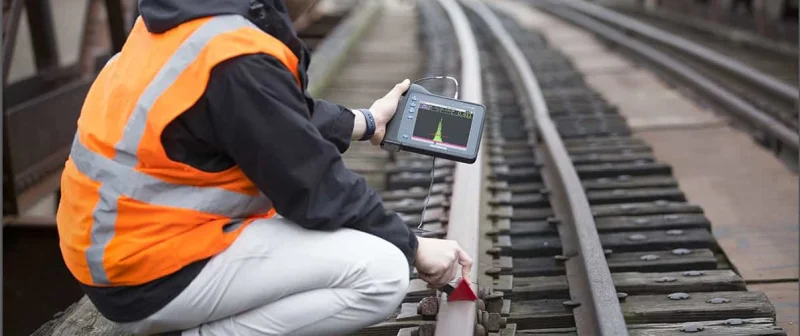
Can you please tell me if ultrasonic testing of stainless steel products is possible ?? I am talking about stainless steel welds. I have seen here that Phased Array can be performed but what about conventional ultrasonic testing?
-
Good afternoon, dear members of the forum. During the training, the lecturer voiced one thought - that none of the existing NDT methods, even their combination, will give a 100% guarantee of the purity of the welded joint. Do you think he is right or wrong? I will not specify what kind of training, it's just really possible to say that the weld is 100% clean. Thank you all in advance!
-
 Discussiontrent started the discussion Liquid Penetrant Testing (NDT) Video in the forum Dye Penetrant Inspection6 years ago
Somebody might find it useful
https://www.youtube.com/watch?v=kL2koZRNcb0
👍1 -
Iridium 192, when shot with 30 curie for 45 mm thick weld joint, RT film (D7) is ok in terms of density and IQI but clarity is not there in the film.
Is it advisable to shoot such high thickness with Iridium, if so how to get good images?1 comment -
The combination of tensile stress and a specific corrosive environment can crack stainless steels. This mode of attack is termed stress corrosion cracking (SCC). The most common environmental exposure condition responsible for SCC of stainless steels is the presence of chlorides. Although no stainless steel grade is totally immune to chloride SCC, the relative resistance of stainless steels varies substantially.
Influence of Alloy CompositionThe relative resistance to chloride SCC is dependant on the stainless steel family. The austenitic family of stainless steels is the most susceptible. The resistance of austenitic stainless steels to SCC is related to the nickel content of the steel.
The most susceptible austenitic grades have nickel contents in the range of 8 to 10 wt%. Therefore, standard grades such as 304/304L and 316/316L are very susceptible to this mode of attack. Austenitic grades with relatively high nickel and molybdenum contents such as alloy 20, 904L, and the 6% molybdenum super austenitic grades have substantially better chloride SCC resistance.
The ferritic family of stainless steels, which includes grades such as type 430 and 444 is very resistant to chloride SCC. The duplex stainless steel with their dual austenite/ferrite microstructures has a resistance that is in between that of the austenite and ferrite grades.
Corrosion TestingThe relative resistance of a stainless steel to chloride SCC is often quantified by the use of standard boiling salt solutions. The table attached summarizes the results of testing in boiling salt solutions of 26% NaCl (sodium chloride), 33% LiCl (lithium chloride), and 42% MgCl2 (magnesium chloride). The boiling LiCl and MgCl2 test solutions are very aggressive relative to practical applications and only austenitic alloys with compositions that approach those of nickel-base alloys will routinely resist cracking in these test solutions.
Crack Appearance
The typical crack morphology for chloride stress corrosion cracking consists of branched transgranular cracks. Figure 1 shows the cracking that occurred on a 6Mo super austenitic stainless steel (N08367) exposed to 0.2% chlorides at 500 °F (260 °C).
Environmental Factors
The environmental factors that increase the cracking susceptibility include higher temperatures, increased chloride content, lower pH, and higher levels of tensile stress. Temperature is an important variable. When stainless steels are fully immersed, it is rare to see chloride stress corrosion cracking at temperatures below 60 °C (150 °F).
There is a synergistic relationship between dissolved oxygen and the chloride level. If the oxygen level is reduced to the 0.01 to 0.1 ppm range, aqueous solutions containing low to moderate chloride levels are not likely to crack austenitic alloys, such as 304L and 316L. The normal solubility of O2 in water at room to moderate temperatures (e.g. up to 140°F/60°C) is 4.5 to 8 ppm at atmospheric pressure.
In actual service environments, evaporation can produce a local build-up of aggressive corrosive substances, such as chlorides and the H+ ions, resulting in conditions that are substantially more aggressive. Under severe evaporative conditions, stainless steels can crack at temperatures well below the thresholds measured under conditions where there is full immersion. Because of this, one must use caution when specifying materials for applications that involve the evaporation of chloride-bearing solutions on hot stainless steel surfaces.
The Materials Technology Institute (MTI) of the Chemical Process Industry has reviewed the literature and collected case histories to define guidelines for the chloride SCC susceptibility of types 304L and 316L stainless steel in neutral water environments.
Figure 2 shows the cracking threshold for 304L and 316L stainless steel as a function of temperature and chloride content. The level of chlorides required to produce cracking is relatively low. Failures have been reported in environments with as little as 10 ppm chlorides. This is particularly true for environments having concentrating (evaporating) mechanisms such as wet/dry interfaces or a film of solution in immediate contact with a heat-rejecting surface. In these situations, a few ppm of chlorides in the bulk solution can concentrate to hundreds of ppm in the area of evaporation.
-
Designation Description
OFW Oxyfuel Gas Welding
SMAW Shielded Metal Arc Welding (MMA)
SAW Submerged Arc Welding
GMAW Gas Metal Arc Welding (MIG/MAG)
FCAW Flux Cored Wire
GTAW Gas Tungsten Arc Welding (TIG)
PAW Plasma Arc Welding
Note
Straight polarity = Electrode -ve
Reverse polarity = Electrode +ve
ASME P Numbers
BaseMetal Welding
Steel and steel alloys P‐No. 1 through P‐No. 15F
Aluminum and aluminum‐base alloys P‐No. 21 through P‐No. 26
Copper and copper base alloys P‐No. 31 through P‐No. 35
Nickel and nickel base alloys P‐No. 41 through P‐No. 49
Titanium and titanium‐ base alloys P‐No. 51 through P‐No. 53
Zirconium and zirconium‐base alloys P‐No. 61 and P‐No. 62
ASME F Numbers
F Number General Description
1 Heavy rutile coated iron powder electrodes :- A5.1
2 Most Rutile consumables such as :- A5.1
3 Cellulosic electrodes such as :- A5.1
4 Basic coated electrodes such as : A5.1
5 High alloy austenitic stainless steel and duplex :- A5.4
6 Any steel solid or cored wire (with flux or metal)
2X Aluminium and its alloys
3X Copper and its alloys
4X Nickel alloys
5X Titanium
6X Zirconium
7X Hard Facing Overlay
Note:- X represents any number 0 to 9
ASME A Numbers
A1 Plain unalloyed carbon manganese steels.
A2 to A4 Low alloy steels containing Moly and Chrome Moly
A8 Austenitic stainless steels
ASME Welding Positions
Welding Positions For Groove welds
Welding Position Test Position
Flat 1G
Horizontal 2G
Vertical Upwards Progression 3G
Vertical Downwards Progression 3G
Overhead 4G
Pipe Fixed Horizontal 5G
Pipe Fixed @ 45 degrees Upwards 6G
Pipe Fixed @ 45 degrees Downwards 6G
Welding Positions For Fillet welds
Welding Position Test Position ISO and EN
Flat (Weld flat joint at 45 degrees) 1F
Horizontal 2F
Horizontal Rotated 2FR
Vertical Upwards Progression 3F
Vertical Downwards Progression 3F
Overhead 4F
Pipe Fixed Horizontal 5F
-
https://www.youtube.com/watch?v=ueFnrcdPVwk
-
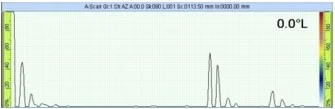
Changed couplant and everything was done as it should be but getting this noise from wedge on Dual Metrix Array probe. Any idea to why?
👍3 -
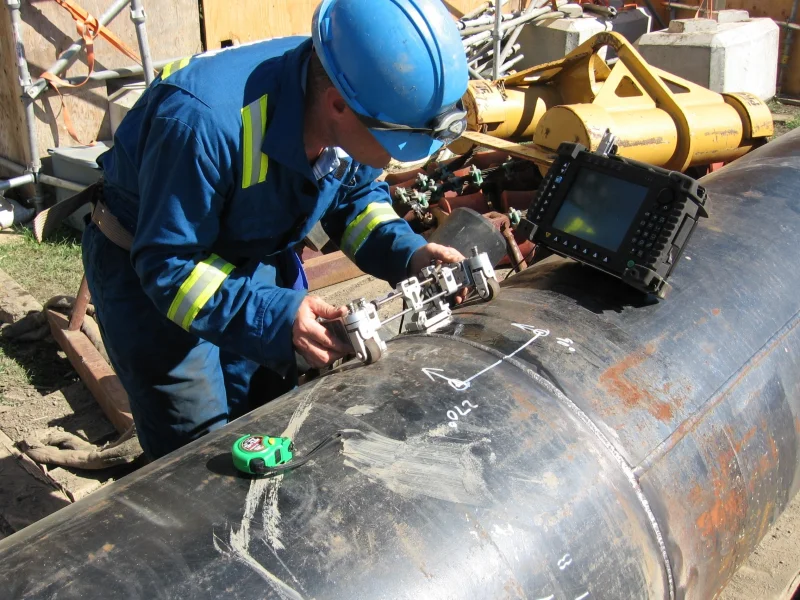
Best way to inspect SS material using PAUT method?
👍1











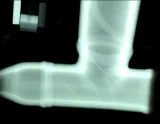









What distance were you using shooting it for 45 minutes? If that was a Long Seam with the same thickness & Ci, I would've shot for a little under 9 mins per shot. What IQI are you using? Is D5 a possibility?