









What’s new on NDT Inspect
Latest NDT & inspection industry news, jobs and community updates
Live updates from the NDT Inspect community: new NDT job vacancies, product launches from the virtual exhibition, forum discussions and member activity across ultrasonic, radiographic, phased array and every other inspection method. Join free to post and follow.
Members post updates, comment, react and follow the companies they work with. Already a member? Sign in
680 posts in UpdatesClear
-
Hydrostatic tests are a type of pressure test that works by filling a component with water and removing the air contained in the device to pressure the system up to 15 times the design pressure limit of the device. Hydrostatic tests include filling a tank or pipe system with liquid water and dyes to support visual leak detection and pressure of the tank and pipe to a specified test pressure.
The test begins by filling the component with liquid water until the pressure reaches a certain level. Detection pressure tests exert pressure internally to determine whether the vessel has leaks or other weaknesses, such as wall thinning, that could lead to failure. Direct expansion methods are permitted in the United States but federal regulations do not require that a permanent total expansion value be recorded. Hydrostatic test requirements and restrictions for pipelines carrying hazardous liquids are specified in 49 CFR 195 (Lower E) and the requirements and restrictions for natural gas pipelines in 49 CFR 192 (Lower J).1 Hydrostatic tests for pipelines carrying hazardous liquids require testing at 125% of the maximum operating pressure (MOP) for 4 continuous hours and another 4 hours at a pressure of 110% when the mop pipelines are not visible.
Hydrostatic (hydro-) tests are the most commonly used method for the leak testing of pipeline systems, boilers, gas cylinders, fuel tanks and other pressure vessels . Hydrostatic tests are a more accurate method of testing pressure vessels than using points such as pipes or chemical cylinders for possible leaks. After construction, hydrostatic pressure tests are used for high stress (30% SMYs) and natural gas pipelines. Hydrostatic testing is a method of testing equipment such as flammable cylinders, storage tanks, gas cylinders and chemical pipelines using hydrostatic testing equipment. Hydrostatic tests are a way for pressure vessels such as pipelines, sanitary facilities, gas cylinder boilers and fuel tanks to test the strength of leaks. Integrity assessment pressure tests are designed to determine whether a hazardous liquid or gas pipeline has sufficient strength and integrity to prevent leaks, cracks and normal operation in disturbed conditions.
The hydrotest ensures that the cylinder can withstand the necessary operating pressure to make it operational, while ensuring that it does not exhibit any leaks or other deformations that could compromise its effectiveness. The low pressure test is a water test of a high-pressure cylinder that tests whether the cylinder can withstand the required pressure and whether there are no leaks or other deformations that would release the pressure.
When testing low-pressure cylinders, it is put into a protective cage in the event it fails or explodes and connected to a water hose to measure how quickly the system is under pressure. At Koorsen, the high pressure cylinders used in CO2-SCUBA and SCBA systems are emptied before the test and filled with water so that the water temperature remains the same in the cylinder and the water jacket to ensure the same accurate readings. Water jacket is a type of hydrostatic test in which a small pressure vessel is filled with water and deposited in a filled test chamber, the so-called test jacket. The vessel is then pressurized to measure the amount of water displaced by the water that fills the chamber and its expansion. When the vessel is pressurized and sealed, the test jacket is filled with water for a certain period of time.
The total expansion value is determined by measuring the amount of water pressed into the vessel by the test pressure and the amount of water discharged from the vessel. This method provides the same measurements as hydrostatic tests in the water mantle (percent permanent expansion and expansion pressure), but is less accurate.
During hydrostatic testing, the pipes of the container are pressurized at normal operating pressure, which has the advantage, however, that a greater margin of confidence in the usability of the system is created.
-
When welding stabilised steels (e.g. Types 321 and 347) at heat treatment temperatures of 550 to 750 degrees Celsius for more than an hour, knife attacks occur at the limit. In short, if you apply the PWHT method to a workpiece at a temperature of 600 degrees F (316 degrees C), the local PWHT carbon in low-alloy steels performs the lowest critical transformation temperature known as subcritical.
Steep temperature differences occur when local heat sources cool the base material before welding. The material is heated to a certain temperature and then cooled down. In order to allow cooling, the material must be heated to a certain temperature based on the type and thickness of the material in order to allow cooling. Heat treatment in all its forms can be used to achieve desirable improvements in properties of a material or to recover properties that are influenced by manufacturing processes such as welding or bending.
While most of us do not consider preheating as a heat treatment form, it is used to reduce the hardness of the three components of the welding : the mother metal, the welded metal and the deposited heat affected zone. This reduces the stress caused by material deformations during the welding activity. PWHT prevents the metal from cracking due to the stresses that occur during welding. HIC occurs when a part is heated to a certain temperature and a certain time is held depending on the type and thickness of material.
This treatment is carried out on carbon steel to ensure a stress-free fine grain structure. The preheating is determined when the entire weld is heated until the material thickness reaches the desired minimum temperature.
The welds must not cool down below room temperature after heating. By heating the material before welding it is possible to diffuse hydrogen from the welding area and prevent hydrogen-induced cracks (HIC). Heat treatment is used after welding to heat and cool the steel in order to reduce the amount of brittle microstructure in the steel and thus to reduce the risk of hydrogen cracking to reduce the risk of hydrogen cracking. Until completion of the welding process, a large number of residual stresses can remain in the material, which can increase potential for stress corrosion and hydrogen-induced cracks. During welding, thick parts of the material are retained, resulting in residual stresses due to local heating, rapid cooling, puddles of welding and solidification. In addition to residual stresses, microstructural changes can occur due to the high temperatures caused by the process. This reduces material strength at supercritical temperatures and increases the likelihood of distortion. Heat treatment after the weld can have both positive and negative effects. In steel production, the most common PWHT method is to use reheating as a stress reliever. By preheating, you consume less heat during the welding arc to achieve optimum penetration of the base material and start at an elevated temperature.
The mechanical properties of alloys and steels are determined by the tempering process of the material, and this temperature should not be exceeded during weld seam production and subsequent stress-relieving temperatures if the mechanical properties of the materials are impaired. In the case of chromium moly steels, pre-heating before welding and re-welding can relieve up to 1400oF. Welding processes with heat-treatable low-alloy steels such as chromium and molybdenum steels can influence these requirements by setting minimum and maximum requirements for pre-heated intermediate temperatures. Heat treatment after welding at temperatures between 510 ° C and 650 ° C can reduce the toughness of the welded metal in heat-affected zones.
Care should be taken to locate the heat treatment on stainless steel temperature gradients on both sides of the heated strip, exposing the material to temperatures outside the critical precipitation range. Selecting the temperature for heat treatment after welding ashted stainless steel structures to relieve residual stresses is not easy, especially with ferritic steel, and the code provides little guidance. During an intermediate degassing process, hydrogen is soaked at 300 degrees Celsius in order to free the welding heat zone (HAZ) of hydrogen.
The main difference between stress reduction and PWHT is that the former makes the temperature a minimum transformation temperature for the steel before any microstructural changes occur in the material. The heat treatment required for welding is heat-treatable in arc welding processes for low alloy steels depending on preheated interpass temperature and subsequent hardening process. Re-welding heat treatment (PWHT), as it is commonly called, is a method of reducing and redistributing the residual stress in the material introduced by welding.
Steel production with PWHT is driven by the need to withstand brittle fractures, and reheating reduces residual stresses much more effectively than stress relief. In addition to reducing and redistributing residual stresses during the welding process, higher temperatures in PWHTs allow for temperature, precipitation and aging effects. Stress reduction reduces stress by controlling the heating of a part to a certain temperature, holding it for a certain period and controlling cooling rate. This process, known as post-weld heat treatment (PWHT), is used to reduce residual stresses as a method of hardness control and to improve material strength.
The extent of relaxation of residual stresses introduced in the material by welding depends on the type of material, composition and temperature of the PWHT water and the time when the temperature is heated. Generally, the part should be heated high enough to allow hydrogen to diffuse through the weld (HAZ), but not too high to cause any kind of microstructural change.
The most susceptible materials for heat treatment after welding at temperatures above 950 degrees Celsius are those that use tungsten carbide solutions.
-
PAUT vs RT
A comparison with RT in this particular application produced the overview presented in the Table below. In conclusion:
• PA dramatically reduces health & safety implications;
• PA offers advantages in saving time and money;
• The advantages and limitations of each technique have been presented;
• Radiography offers benefits for the detection of inclusions and porosity;
• PA can detect all defect types and characterize them in accordance with acceptance criteria.
Table 1. Comparison between inspection performances of PA and RT for a boiler tube inspection
 👍2
-

-

-
Corrosion Mapping. Visible corrosion and pitting at 6 o'clock position. View in Tomoview and Omni PC.
👍3 -
ToFD calibration
 👍2
-
Weld cracking open to the surface. ToFD Inspection.
 👍4 2 comments
-
Calibration block (pipe) sample for carbon steel pipe with stainless steel cladding. Flat bottom holes. Material thickness: Carbon Steel: 13.0mm, Stainless Steel (Cladding): 4.0mm
 👍3
-
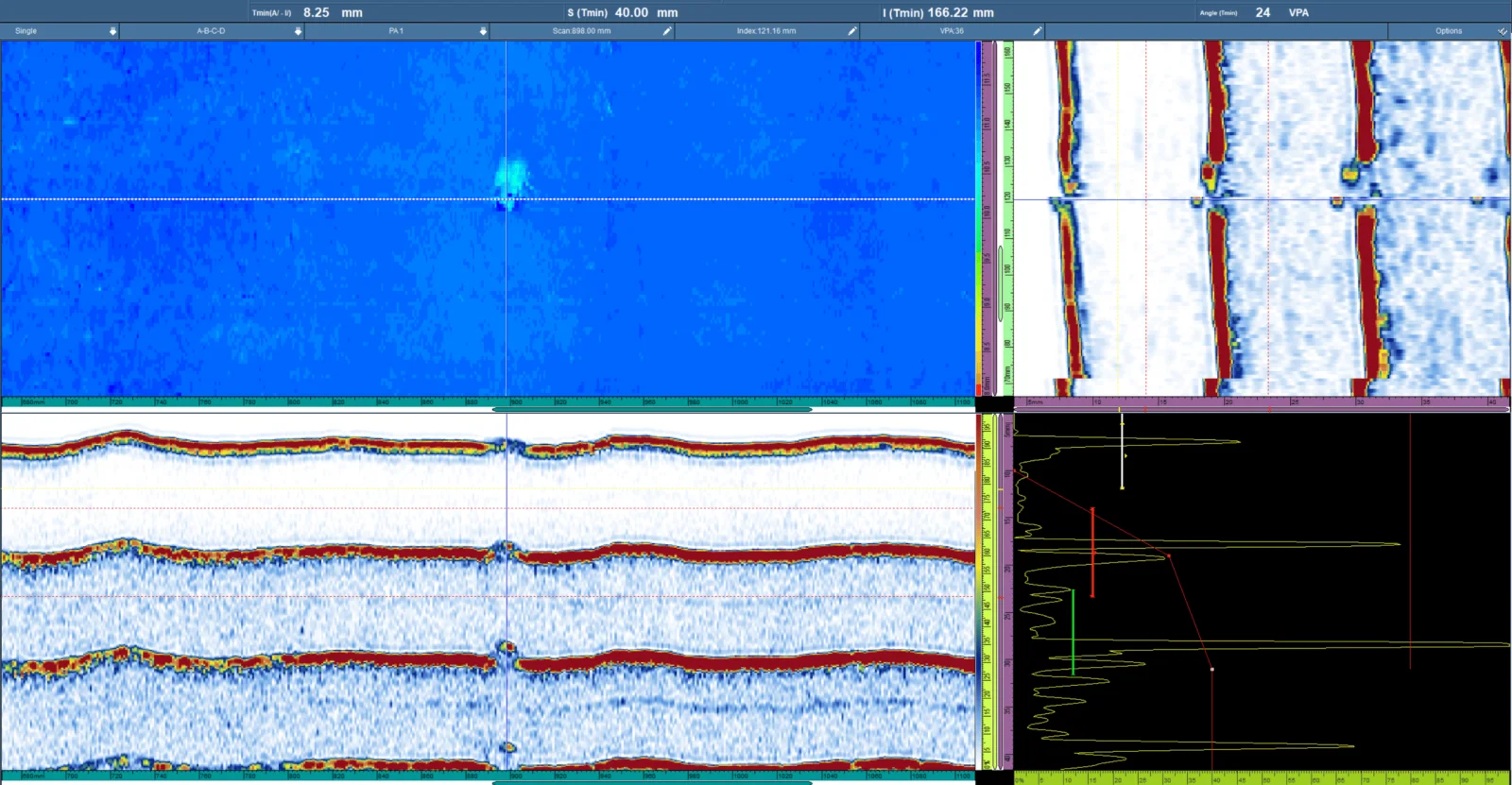
Isolated pit on a pipeline. Omni PC quick analysis. Data collected with Hydroform search unit and Omniscan MX2
 👍4
-
@all If you have registered in the past 1-2 days, you might need to register again as we have updated database. Sorry for inconvenience caused. This is the only update and will not be happening again. Your admin team @doug
👍1 -
-

-

-
Weld root fusion UT vs PAUT
👍1 -
 👍1
-
😀
 👍1
-
проведение ККД на трубном пучке

-
еще немного трещин

-
A crack was visually detected on the heat exchanger baffle
Визуально обнаружена трещина на перегородке теплообменника
-
Трещина 150 мм на корпусе задвижки

-
Visual inspection and marking of defective areas
Визуальный осмотр и разметка дефектных участков
 👍2
-

-

-
























😱
Yep. I guess it was a leak if in service pipe/ weld.