

Welcome to NDT Inspect's Magnetic Particle Inspection (MPI) group, a place for professionals to connect and discuss the latest techniques and technologies in magnetic particle inspection. MPI is a non-destructive testing method that uses a magnetic field and iron oxide or iron oxide-coated magnetic particles to inspect the surface of ferromagnetic components such as pipelines, tanks, and pressure vessels. Our member group offers a platform for sharing knowledge and best practices on MPI and its applications in various industries. Join our community of experts from around the world and be a part of the conversation on advancing the practice of magnetic particle inspection.
Updates
-
 Mark Gilmour posted an update in the group Magnetic Particle Inspection (MPI) (MT)12 hours ago
MT challenge: a crack along the weld. Which way would you magnetise?
Look at the two arrangements in the illustration. Consider the local magnetic field at the crack, assuming adequate field strength and suitable inspection conditions.
Which field direction is most favourable for detecting the crack?
A) Parallel to the crack
B) Across the crack, approximately at right angles
C) Either direction is equally favourable
D) Field direction does not matter
What would you choose, and why? Add your reasoning below. My answer is below
Answer: B) Across the crack, approximately at right angles.
Magnetic particle testing is most sensitive when the local magnetic field crosses the crack rather than running along it. In the illustration’s left-hand arrangement, the field crosses the longitudinal crack.
This is why inspections commonly use two approximately perpendicular magnetisation directions when discontinuity orientation is unknown. Orientation alone does not demonstrate adequate field strength or coverage: follow the approved technique and required verification checks.
More illustrated revision in NDT Pro Study Plus:
https://ndt-pro-study-plus.pplx.app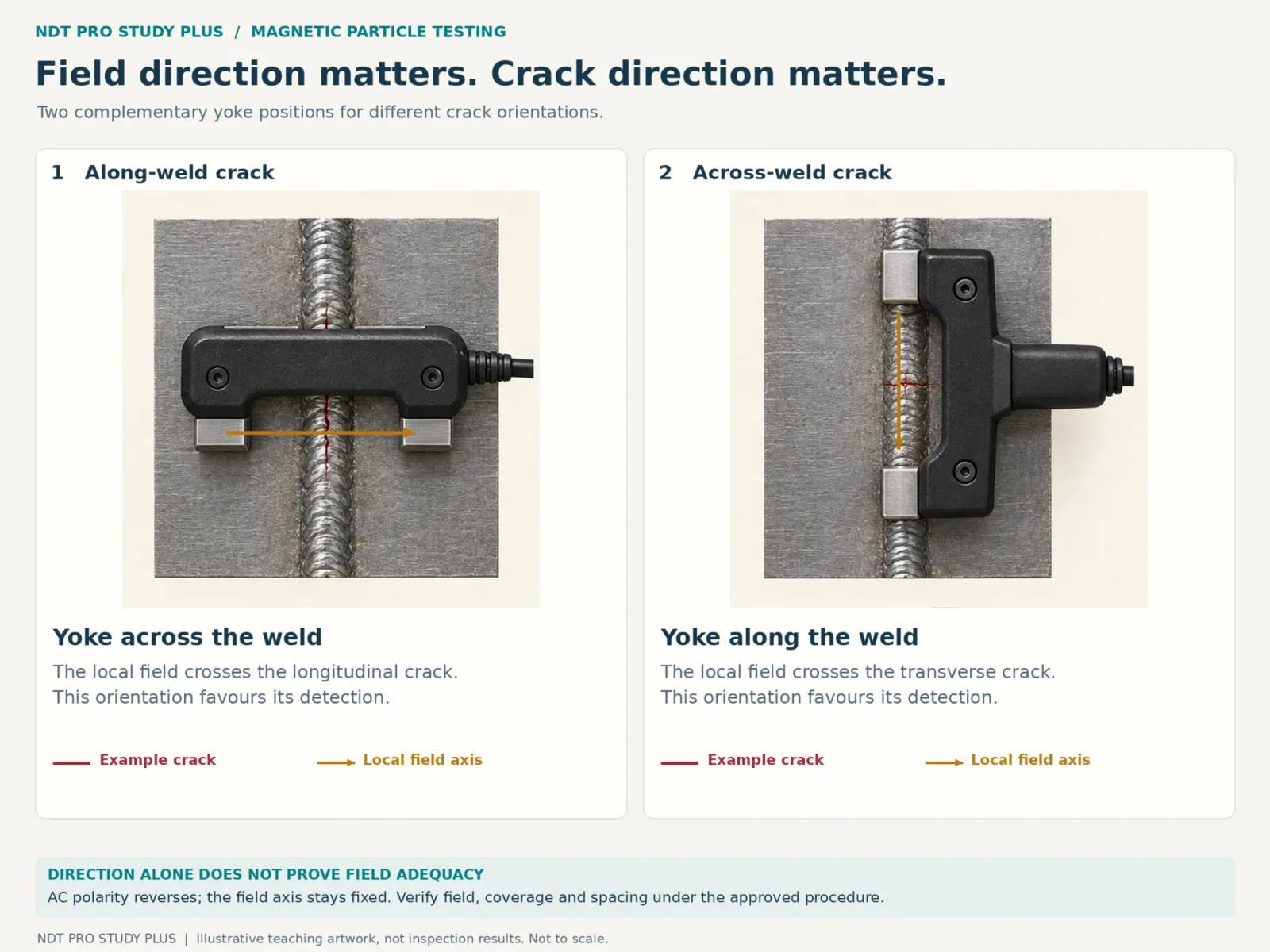
-
Mark Gilmour joined the group Magnetic Particle Inspection (MPI) (MT)12 hours ago
-
 stig-skarpenes shared a photo in the group Magnetic Particle Inspection (MPI) (MT)6 days ago
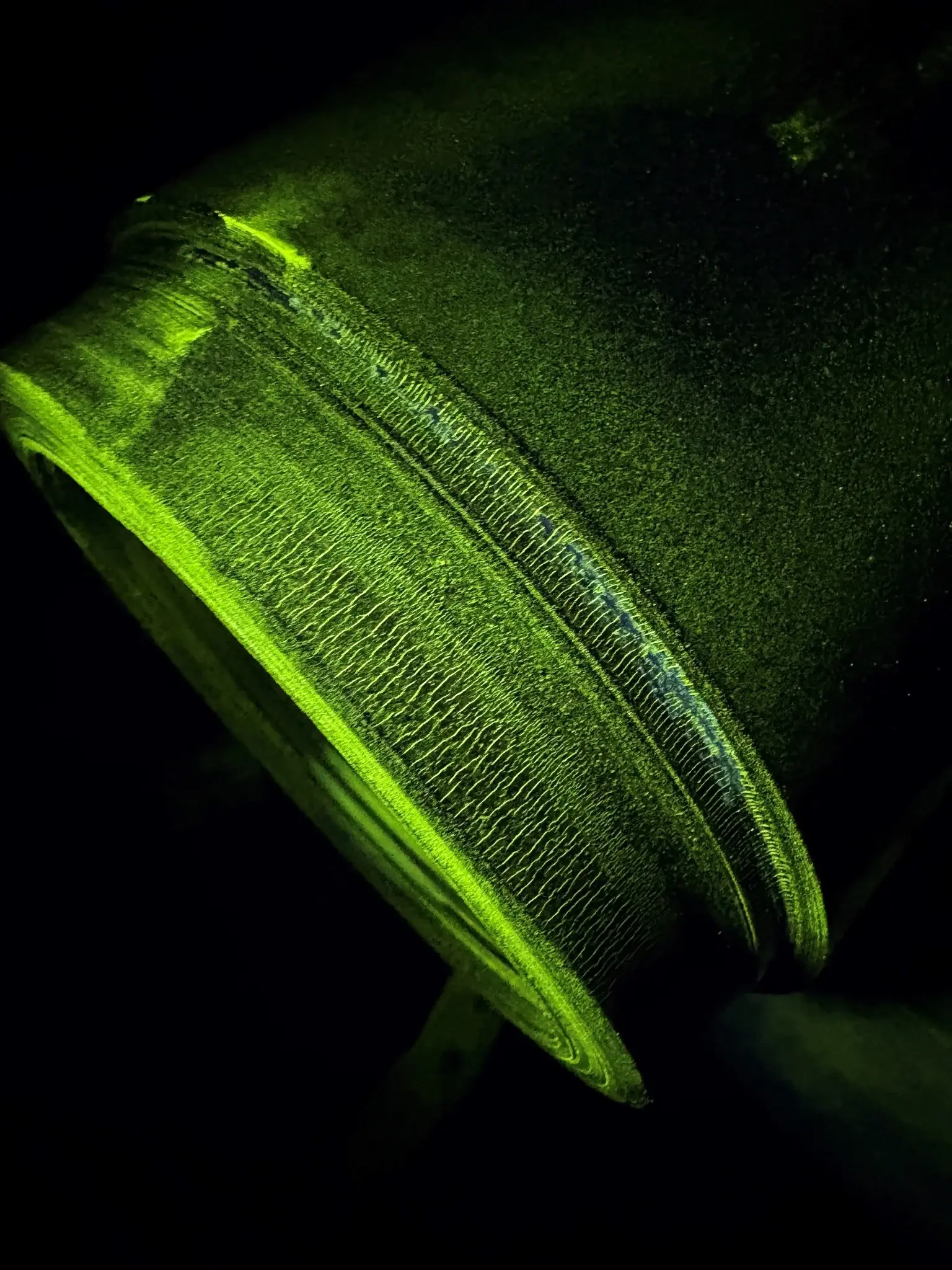
Found with yoke
 👍1
👍1 -
stig-skarpenes posted an update2 years ago
Weak indication found with coil. Picture are taken after use of Yoke.
 👍2
👍2 -
 3 years ago
Elevated temperature magnetic particle inspection is a type of non-destructive testing (NDT) that is used to detect defects in ferromagnetic materials, such as steel and iron, at elevated temperatures. This type of testing is commonly used in the aerospace, oil and gas, and power generation industries, where components and structures are subjected to high temperatures during operation.
Elevated temperature magnetic particle inspection is based on the principle of magnetic induction, which states that a magnetic field will be generated around a ferromagnetic material when it is subjected to a current. When a defect is present in the material, the magnetic field will be distorted, and this distortion can be detected using magnetic particle inspection.
To perform elevated temperature magnetic particle inspection, the component or structure being tested is first magnetized by exposing it to a strong magnetic field. The magnetic field causes the material to become magnetized, and any defects in the material will cause local disturbances in the magnetic field.
Next, a suspension of magnetic particles is applied to the surface of the material. The magnetic particles will be attracted to the areas where the magnetic field is distorted, and they will form visible patterns on the surface of the material that can be used to identify the location and size of the defects.
Elevated temperature magnetic particle inspection can be performed at temperatures up to 600°C, depending on the type of magnetic particles and the equipment used. This allows for the detection of defects in materials that are too hot to be inspected using other NDT methods, such as visual inspection or ultrasonic testing.
To perform elevated temperature magnetic particle inspection, specialized equipment is required. This equipment typically consists of a magnetizing unit, a magnetic particle applicator, and a means of illuminating the surface of the material being inspected. The magnetizing unit is used to generate the strong magnetic field that magnetizes the material, while the magnetic particle applicator is used to apply the suspension of magnetic particles to the surface of the material. The illuminating device, such as a UV light or fluorescent dye, is used to make the magnetic particle patterns visible on the surface of the material.
Elevated temperature magnetic particle inspection is performed by trained and certified NDT technicians who use the specialized equipment to magnetize the material, apply the magnetic particles, and interpret the resulting patterns to identify defects. The technician may also use other inspection techniques, such as visual inspection or surface roughness measurement, to supplement the magnetic particle inspection and provide a more complete picture of the condition of the material.
Overall, elevated temperature magnetic particle inspection is a valuable tool for detecting defects in ferromagnetic materials at elevated temperatures, and it is commonly used in industries where components and structures are subjected to high temperatures during operation. This type of testing allows for the early detection and repair of defects, which can help to prevent failure and improve the safety and reliability of critical components and structures.
-
NDT-Inspect posted an update in the group Magnetic Particle Inspection (MPI) (MT)3 years ago
Did you know:
MPI (magnetic particle inspection) is a non-destructive testing (NDT) method that is used to detect surface and near-surface defects in ferromagnetic materials, such as steel and iron. In MPI, a magnetic field is applied to the material being tested, and fine iron oxide or iron oxide-coated particles are introduced onto the surface.
The particles are attracted to areas of the material where there are defects, such as cracks or inclusions, and they form a visible pattern that indicates the location and size of the defects.
MPI is not typically used on non-ferromagnetic materials, such as aluminum or copper, because the magnetic field cannot penetrate these materials and the iron oxide particles will not be attracted to any defects.
Other NDT methods, such as ultrasonic testing or radiography, may be more suitable for inspecting non-ferromagnetic materials.
-
NDT-Inspect posted an update in the group Magnetic Particle Inspection (MPI) (MT)3 years ago
Magnetic particle testing is a nondestructive testing (NDT) method that is used to detect surface and slightly subsurface discontinuities in ferromagnetic materials.
The test is performed by applying a magnetic field to the material and then introducing a fine iron or iron oxide powder, called magnetic particles, onto the surface of the material.
The magnetic particles will be attracted to areas of the material where there are discontinuities, such as cracks, and will form a visible indication that can be easily seen and evaluated.
This method is commonly used to inspect welds, castings, and other ferromagnetic materials for defects that could affect the strength and performance of the material.
-
NDT-Inspect posted an update in the group Magnetic Particle Inspection (MPI) (MT)3 years agoMPT Magnetic Particle Testing (NDT)
/mpt-magnetic-particle-testing-ndt/
-
 mohana-sundaram posted an update in the group Magnetic Particle Inspection (MPI) (MT)3 years ago
Hi sir. Iam Mohana sundaram completed ASNT level II in UT RT MPT PT and i've done lamination mapping as a freelancer. Is there any job vaccancies available sir.
1 comment -
NDT-Inspect posted an update in the group Magnetic Particle Inspection (MPI) (MT)4 years ago👍2
-
 4 years ago
I am seeking info regarding the indications shown in the image.
This is a training test piece for MT; however, I have also observed similar indications when testing aircraft bolts and other components (strut fittings, etc). They are straight, linear with no visible indication under a microscope.
I am looking to see what is causing these indications.
Any advice will be greatly appreciated. Thanks! -
4 years agoMagnetic particle inspection methods vary in terms of ease of use as well as the level of detail.
Magnetic particle inspection (MPI) can be performed a number of different ways and oftentimes any of these methods are acceptable under the specification called out for performing the test. In many cases, these specifications leave the door open for the nondestructive testing personnel to select the method for performing the inspection. But, be aware that all methods are not created equal. As explained below, they not only vary in terms of ease and time to perform, but also in the level of detail provided in the test results.
Since safety and reliability are priorities for anyone in a position responsible for quality, when given an option, it makes sense to choose the MPI method for your finished products that will provide the most dependable results. When purchasing inspected material, you may want to dig a little deeper to find out how the material was certified:
- Type of electrical current used to create the magnetic field in the test piece
- Type of medium or particles used to perform the testing
For this article, three different magnetic particle inspection methods were performed on the same test piece for comparison. Any of the three would be acceptable for meeting the requirements of many base specifications. The following techniques were utilized:
- Visible dry powder with an alternating current (AC) yoke
- Visible dry powder using full wave direct current (FWDC) in a horizontal bench unit
- Fluorescent wet by full wave direct current (FWDC) in a horizontal bench unit
Due to the loose powder used in the visible dry method, we know that this process is more labor intensive, messier and takes longer to perform than the fluorescent wet technique. Of more importance, visible dry MPI is also less sensitive than fluorescent magnetic particle inspection. The comparison of our three MPI methods and their results are reviewed below to make this point.
By choosing these different test methods, we are able to compare the impact of each of the following on the level of detail in the test results:
- Current: AC versus full wave DC
- Medium/Particles—visible dry powder and fluorescent wet suspension
The examples below were taken from an actual order processed in our lab. We were instructed to inspect the same part using the two different visible dry powder magnetic particle techniques mentioned above. Although orders for visible dry powder are common, performing basically the same inspection on the same test piece with two different visible dry processes was not typical. After being surprised by the results, we decided to complete our comparison by inspecting the same part using the fluorescent wet continuous technique with the FWDC bench unit.
Visible Dry Powder with an Alternating Current (AC) Yoke
The initial inspection results using the visible dry powder with the AC Yoke revealed only what would be termed as gross surface defects (forging laps) in an as-forged area of the test piece. These defects were in fact severe enough to be seen by visual inspection with the naked eye. We observed no magnetic particle indications in the machined areas of the part.
Visible Dry Powder using Full Wave Direct Current (FWDC) in a horizontal bench unit
The next inspection was performed with visible dry powder and a direct contact head shot followed by a coil shot using FWDC in our horizontal bench unit. This particular test is not often performed, so our first concern was to protect the fluorescent bath and as much of the bench unit as possible from contamination by the visible particles.
In all honesty, we didn’t expect to see much difference in the results from the previous visible dry powder inspection using the AC yoke. We were confident that the gross defects (forging laps) previously observed would be detected again. Other than the as-forged areas, the part appeared to be of very high quality in the machined areas. What we didn’t expect to find—which is part of the fun of NDT—were the multiple linear indications believed to be inclusions or stringers throughout the machined areas of this test piece. These indications were not found using the visible dry powder with the AC yoke and could potentially be detrimental to the part, depending on its application.
We concluded that the more detailed results were due to the different current used in our bench unit, since DC current is deeper penetrating than AC. While AC current can successfully detect surface discontinuities, DC current can locate deeper and more hidden defects such as these stringers and inclusions.
Fluorescent Wet by Full Wave Direct Current (FWDC) in a Horizontal Bench Unit
The final inspection of our study was performed using the fluorescent wet continuous method in the FWDC bench unit. As expected, the gross defect in the forged area was easily found again. Also as expected, the multiple linear indications believed to be inclusions/stringers in the machined areas were even more pronounced and much more populous than observed by the previous visible dry powder inspection.
Since all other factors were the same for the two tests performed in the bench unit, we attribute the more defined results of the fluorescent wet inspection to the medium used and the lighting in the inspection area. While both visible dry and fluorescent wet inspections are performed by covering the test surface in fine iron oxide particles while applying a magnetic field, the application and inspection processes differ. The visible dry powder is applied and removed by hand, which leaves room for human error, and the results are observed under a standard white light. The fluorescent method allows for the use of smaller particles transported in a liquid bath for better flow to small leakage fields, and these test samples are evaluated in a darkened inspection area under a black light where the fluorescent colors provide better visibility of indications.
In conclusion, when the MPI test method is not specified, opt for the fluorescent wet method over visible dry inspection. This will help ensure that you are getting the most reliable test results and information about your materials and finished products. If visible dry is required, the use of the HWDC unit is definitely the best option to ensure accurate results.
-
NDT-Inspect posted an update in the group Magnetic Particle Inspection (MPI) (MT)4 years ago

-
NDT-Inspect posted an update in the group Magnetic Particle Inspection (MPI) (MT)4 years ago

-
NDT-Inspect posted an update in the group Magnetic Particle Inspection (MPI) (MT)4 years ago

Discussions














HI, please fell free to submit your CV on following link: /resumes/ This post will be removed as it has been placed in MPI Section.